ما الذي تبحث عنه ؟


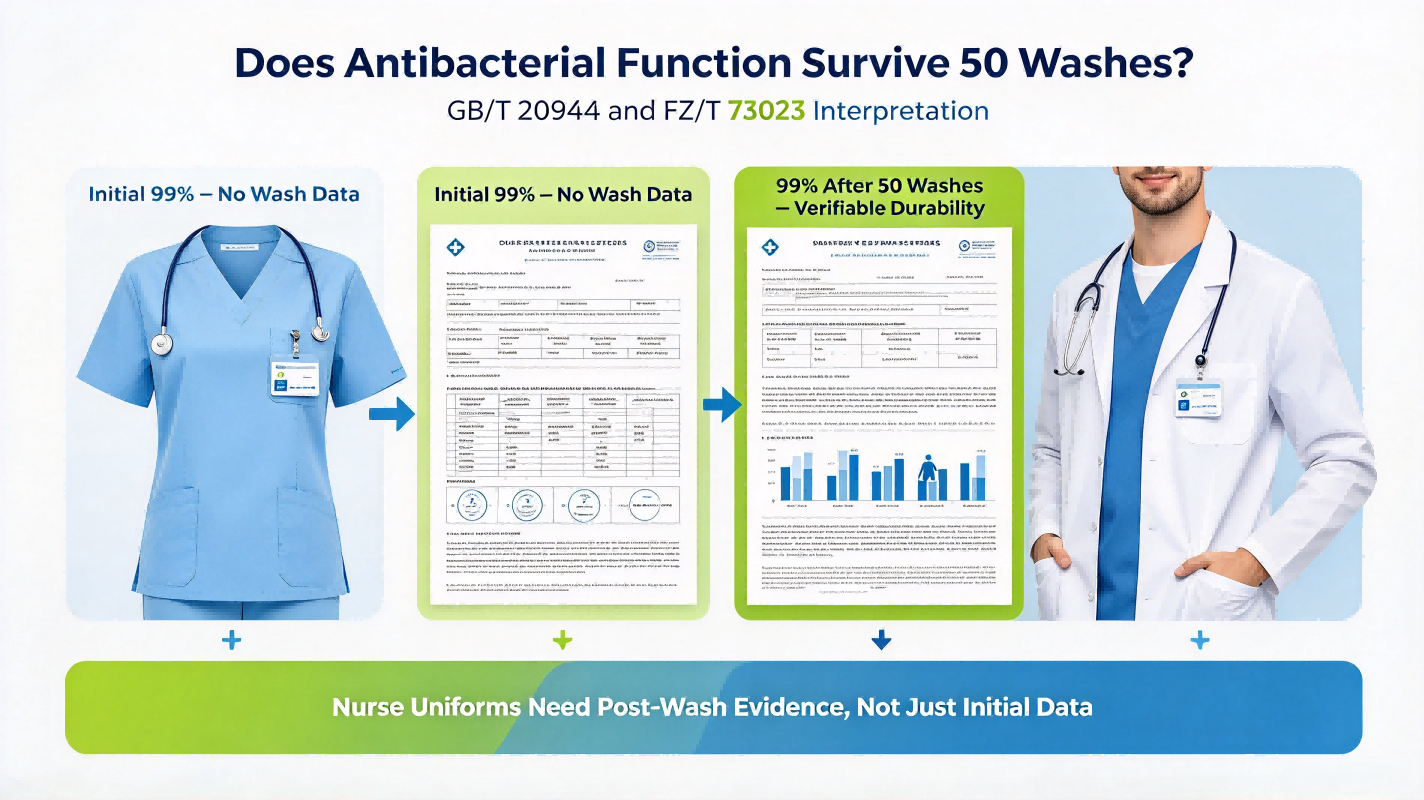
When buying antibacterial nurse uniforms, one of the easiest traps to fall into is this: the supplier presents a test report showing an inhibition rate of 99%—looks impressive. But you search the entire report and can't find the words "number of washes."
An initial inhibition rate of 99% and an inhibition rate of 99% after 50 washes are two completely different things. Nurse uniforms are washed two or three times a week, and also go through high-temperature and chlorine disinfection. If the antibacterial function is gone after a dozen or so washes, that impressive test report has no practical meaning.
Whether antibacterial nurse uniforms can withstand washing can't be judged by feeling—it has to be based on two standards: GB/T 20944 and FZ/T 73023. Today, we're going to explain the division of labour between these two standards, their grades, and how to use them in procurement.
1. Two standards, each with its own role – first, get the division of labour clear
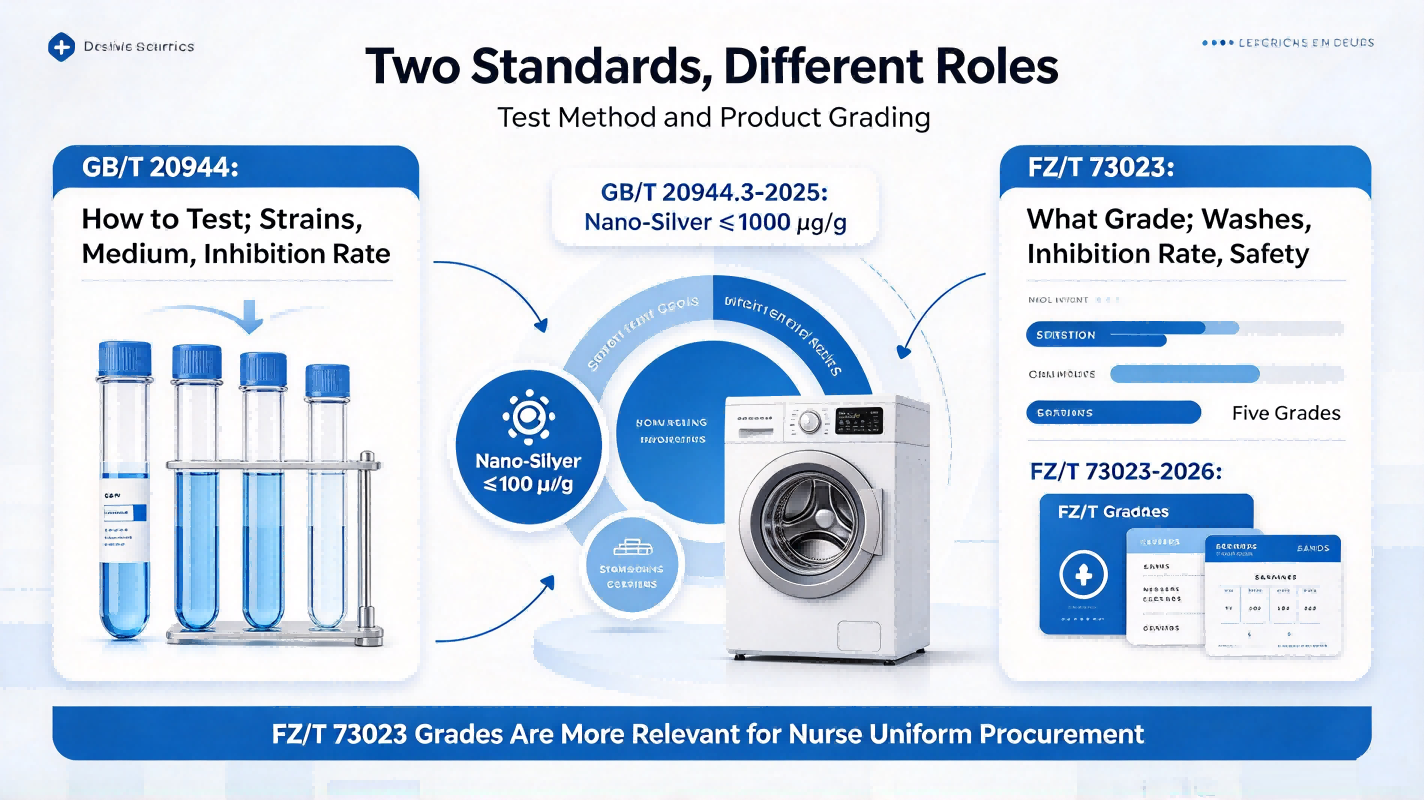
GB/T 20944 and FZ/T 73023 are often mentioned together, but they don't govern the same thing.
GB/T 20944 "Textiles – Evaluation of antibacterial performance" is a test method standard. It specifies "how to test"—which bacterial strains, what medium, what temperature, how long to culture, and how to calculate the inhibition rate. The latest version is GB/T 20944.3-2025 (oscillation method and absorption method). The 2025 revision added a key safety requirement: nano-silver limit not exceeding 1000 μg/g.
This standard answers "does this fabric have an antibacterial effect," but it does not itself specify "how many washes it must still be effective after."
FZ/T 73023 "Antibacterial knitwear" is a product grading standard. It specifies "what level must be reached to qualify, and what grade it counts as"—the core variables being number of washes and inhibition rate. The new version FZ/T 73023-2026 was released in April 2026 and will be implemented on 1 May 2028, expanding the antibacterial grades from the original 3 levels to 5 levels.
In nurse uniform procurement, the grades in FZ/T 73023 are more relevant than the pass line in GB/T 20944, because the core pain point for nurse uniforms isn't "whether it has antibacterial properties" but "whether it still has them after dozens of washes."
2. The grade thresholds in FZ/T 73023: AAA is the starting point for nurse uniforms, not the endpoint
The old version of FZ/T 73023 (2006 version) had only three grades: A, AA, and AAA. Grade AAA requires that after 50 washes, the inhibition rate against Staphylococcus aureus be ≥80%, against Escherichia coli ≥70%, and against Candida albicans ≥60%. This threshold has been the baseline for mainstream antibacterial knitwear on the market for over a decade.
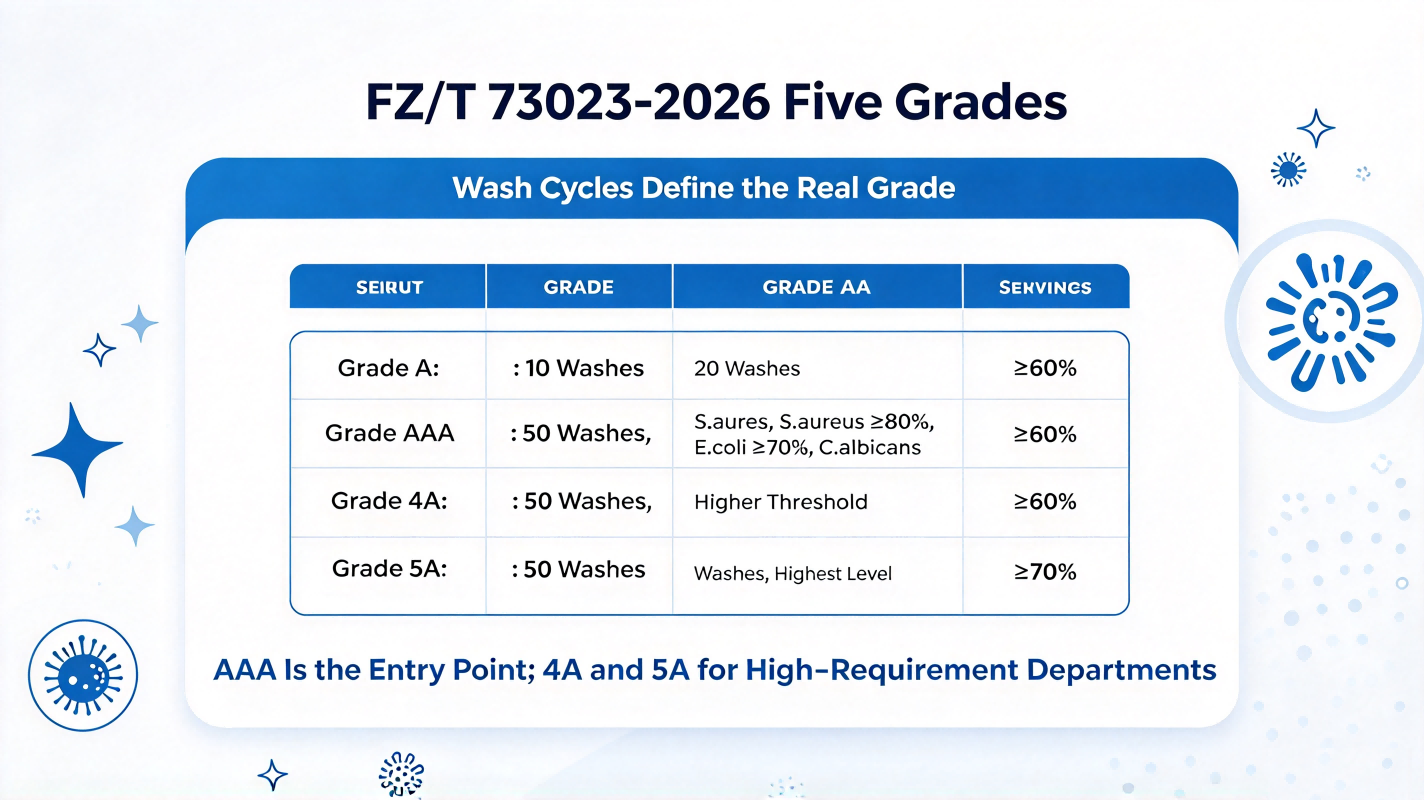
The new version FZ/T 73023-2026 retains and refines the A, AA, and AAA levels.while adding Grade 4A and Grade 5A, raising the bar for "long-lasting antibacterial" significantly. The five grades in the new version are as follows:
|
Grade |
Wash cycles |
Staphylococcus aureus |
Escherichia coli (or Klebsiella pneumoniae) |
Candida albicans |
|
Grade A |
10 washes |
≥99% |
Not assessed |
Not assessed |
|
Grade AA |
20 washes |
≥80% |
≥70% |
≥60% |
|
Grade AAA |
50 washes |
≥80% |
≥70% |
≥60% |
|
Grade 4A |
50 washes |
≥90% |
≥90% |
≥80% |
|
Grade 5A |
50 washes |
≥99% |
≥99% |
≥85% |
Data source:
What nurse uniform buyers should focus on most in this table is the progressive relationship among AAA, 4A, and 5A.
Grade AAA is the "pass line" after 50 washes: after 50 washes, inhibition rates of 80% against Staphylococcus aureus and 70% against Escherichia coli qualify for this grade. For general wards, outpatient departments, and other routine departments, Grade AAA can serve as a basic requirement.
But for ICU, emergency, infectious diseases, operating rooms, and other high infection-control departments, AAA's 80%/70% isn't enough. Grade 4A raises the post-50-wash threshold to 90%/90%/80%, and Grade 5A pushes it to 99%/99%/85%. In actual procurement, some hospitals have already explicitly required in tender documents: "after 50 washes, anti-Staphylococcus aureus ≥90%, anti-Escherichia coli ≥96%, complying with FZ/T 73023 Grade AAA standard" – this indicator actually exceeds the old AAA threshold and is closer to the 4A approach.
In one sentence: Grade AAA is the entry ticket for nurse uniform antibacterial performance; 4A and 5A are the indicators high-requirement departments should look at.
3. Why is "50 washes" the watershed for nurse uniform antibacterial performance?
50 isn't an arbitrary number.
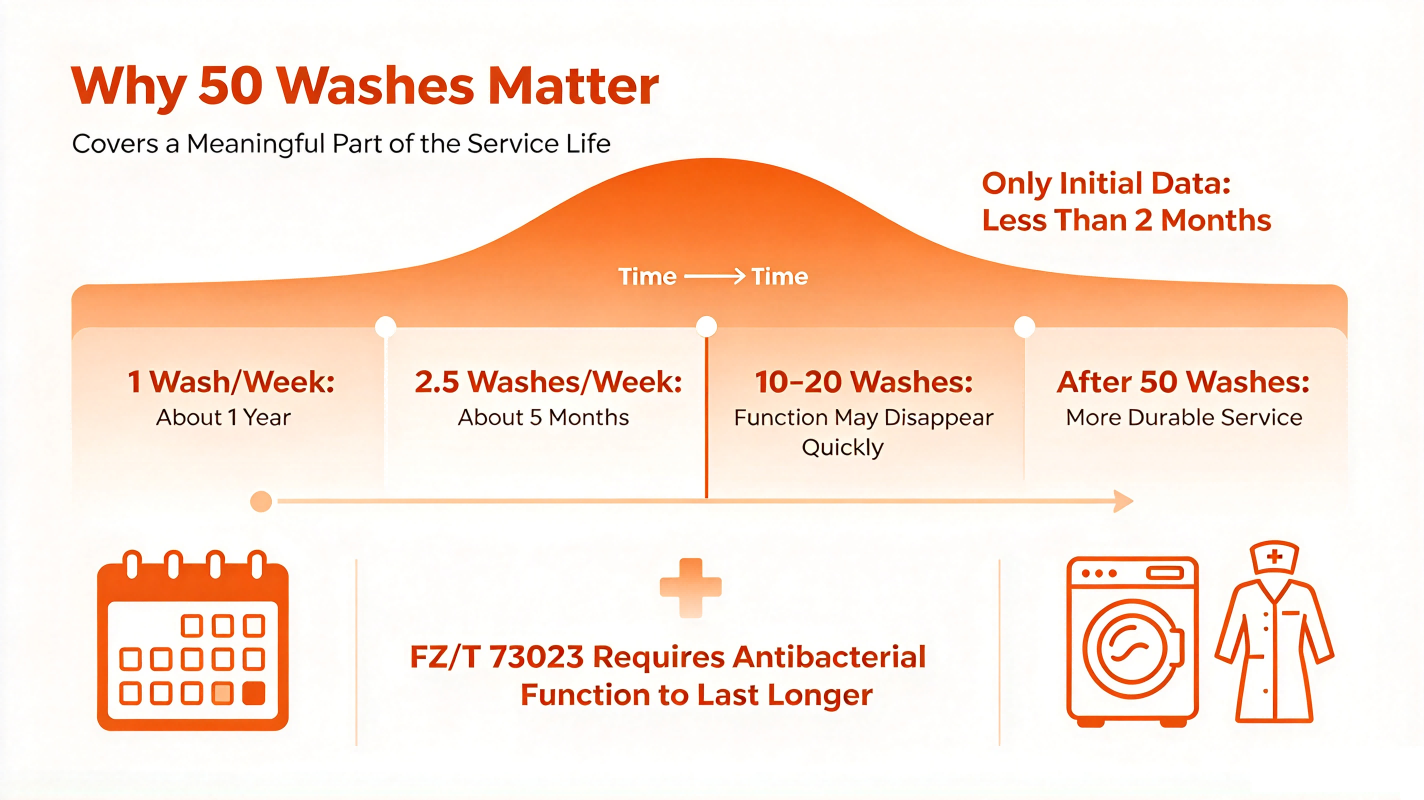
According to WS/T 508-2025, medical staff workwear should be washed and disinfected at least once a week, and in actual practice many departments wash two or three times a week. At 2.5 times per week, 50 washes corresponds to roughly 5 months of use.
The normal service life of a nurse uniform is usually 1 to 2 years. If the antibacterial function only lasts 10 or 20 washes, it means within less than two months, this "antibacterial nurse uniform" has degraded into an ordinary nurse uniform. FZ/T 73023 sets the AAA wash threshold at 50 precisely because it requires the antibacterial function to cover at least a meaningful portion of the nurse uniform's service life.
The old AAA grade (80%/70%/60%) governed "still has basic effect after 50 washes"; the new 4A grade (90%/90%/80%) governs "effect is still solid after 50 washes"; Grade 5A (99%/99%/85%) governs "almost no degradation after 50 washes." During procurement, asking clearly "what's the report after how many washes" is far more useful than asking "is it antibacterial."
4. The pass line in GB/T 20944 is not the same thing as FZ/T 73023
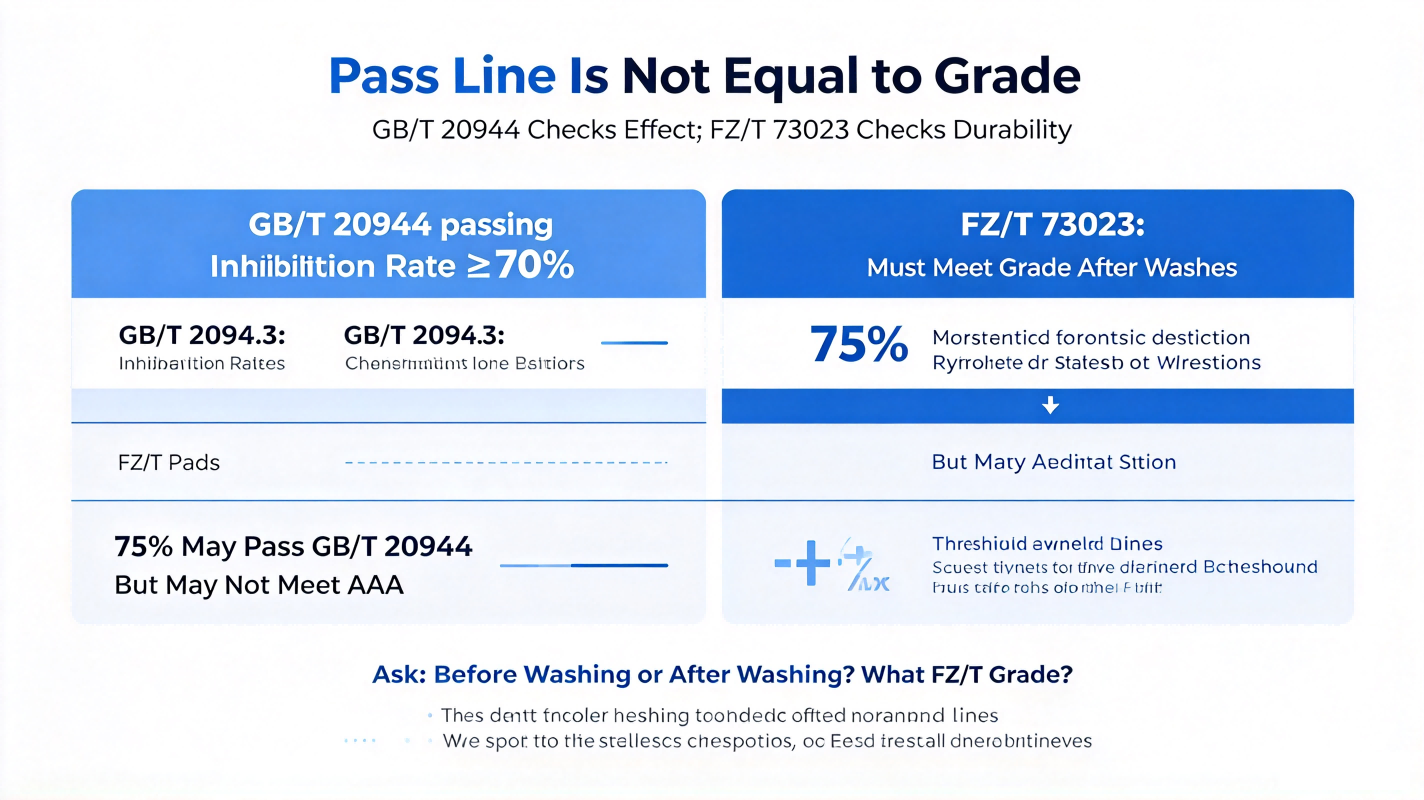
As a test method standard, GB/T 20944.3-2025 itself provides the basic threshold for judging "has antibacterial effect." When using the oscillation method, an inhibition rate of ≥70% against Staphylococcus aureus and Escherichia coli and ≥60% against Candida albicans is generally judged as having antibacterial effect. If a supplier claims "good antibacterial effect," it often needs to reach ≥90% or higher.
This means a common confusion: a nurse uniform tested according to GB/T 20944.3 with an inhibition rate of 75% can be called "passing"; but graded according to FZ/T 73023, it may not even meet the wash-durability threshold for Grade AAA. GB/T 20944 governs "does it test as having antibacterial effect"; FZ/T 73023 governs "is it still sufficient after dozens of washes."
During procurement, if the supplier only presents a GB/T 20944 report, you must follow up with: Was this report tested before washing or after washing? What grade does it reach under FZ/T 73023?
5. An easily overlooked safety indicator: zone of inhibition width
Both the new FZ/T 73023-2026 and GB/T 20944.3-2025 strengthen safety constraints beyond "antibacterial effect."
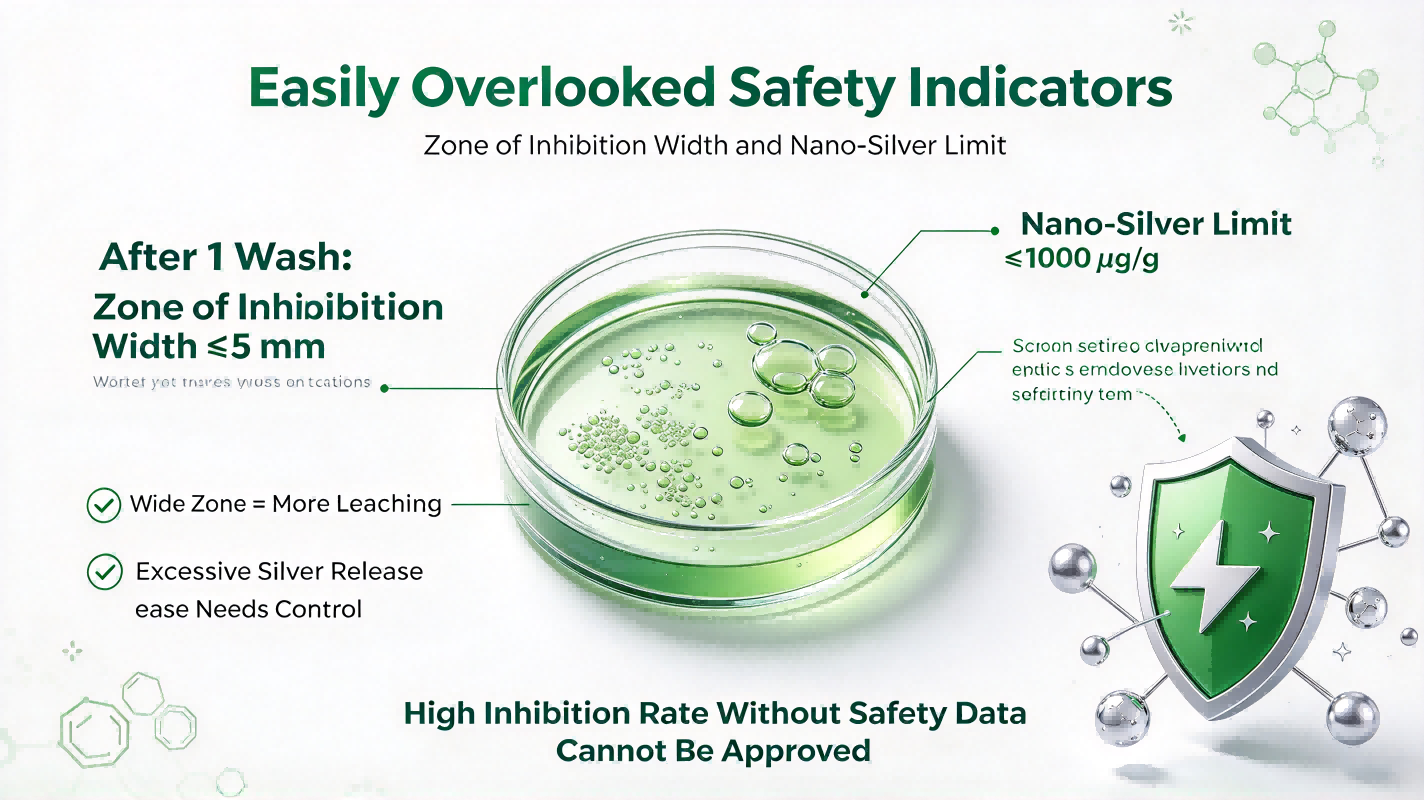
FZ/T 73023-2026 requires that after 1 wash, the zone of inhibition width of the sample be ≤5 mm. This indicator governs the leaching property of the antibacterial agent. The wider the zone of inhibition, the more easily the antibacterial agent "leaches out" from the fibre. Although leaching antibacterial agents kill bacteria quickly, for nurses who wear the garment against their skin 8 to 12 hours a day, the continuous release of antibacterial components onto the skin surface may pose irritation risks and is also detrimental to long-lasting durability.
The nano-silver limit ≤1000 μg/g newly added in GB/T 20944.3-2025 governs the boundary for the use of silver-based antibacterial agents. Silver ions have strong antibacterial power, but the release of excessive silver needs to be controlled.
Together, these two safety indicators point to the same logic: for nurse uniform antibacterial performance, you can't just look at "how hard it kills" – you also need to look at "whether the antibacterial agent leaches out, and how much." A product with an excessive zone of inhibition width, even with impressive inhibition rate data, cannot correspond to the appropriate grade under the FZ/T 73023-2026 system.
6. How to use these two standards in procurement? Check the report, ask the grade, verify safety
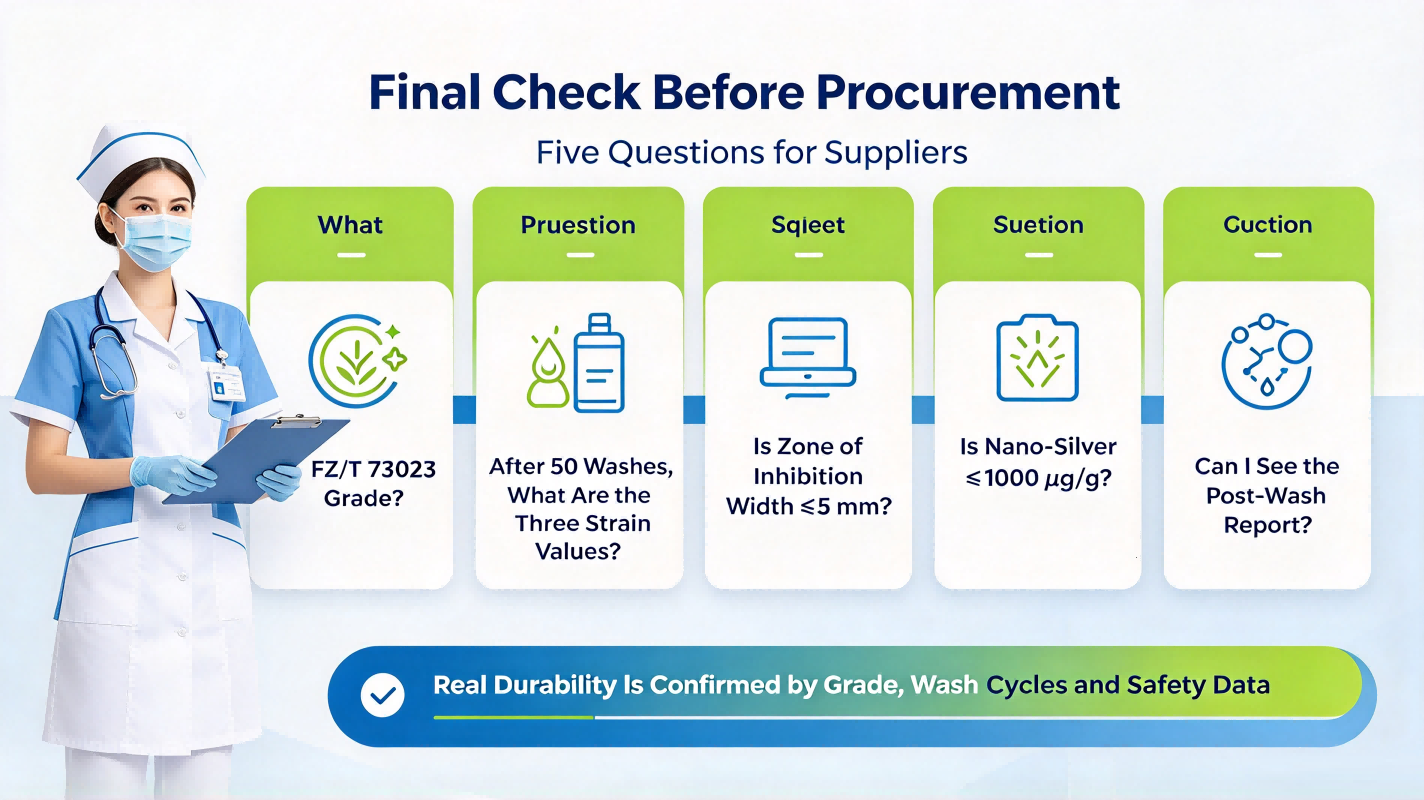
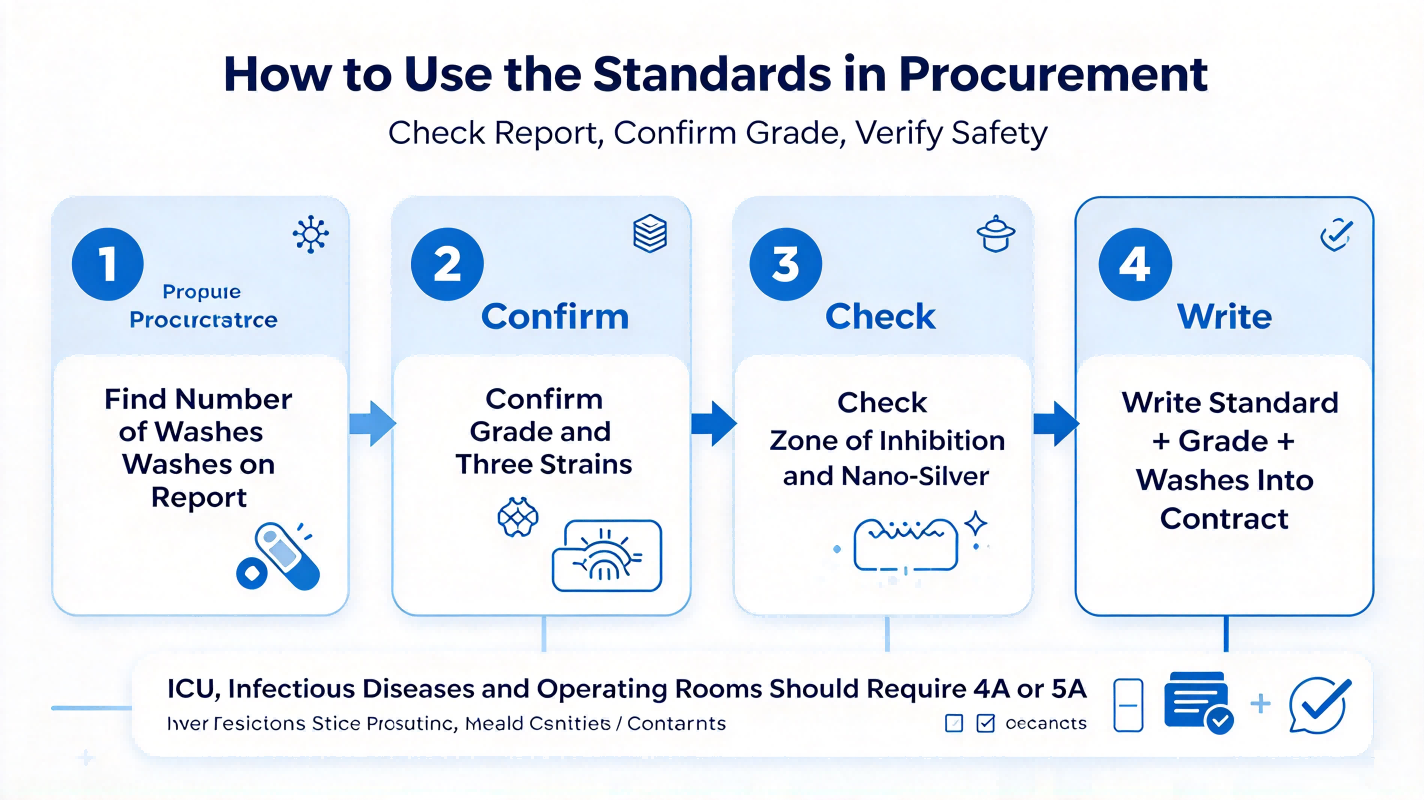
First, find the "number of washes" on the report. Ask the supplier for an antibacterial report tested according to FZ/T 73023 that clearly states the number of washes. A report only giving a "pre-wash inhibition rate 99%" cannot be used as evidence of durable antibacterial performance.
Second, confirm the grade and strains. For routine departments, look at least at Grade AAA (50 washes); for ICU, infectious diseases, and operating rooms, look at Grade 4A or 5A. Inhibition rate data for all three assessed strains (Staphylococcus aureus, Escherichia coli or Klebsiella pneumoniae, Candida albicans) must be provided—not just one.
Third, write safety indicators into acceptance conditions. In addition to inhibition rates, require the supplier to provide test data for zone of inhibition width and nano-silver limit (if silver-based antibacterial is involved). After 1 wash, the zone of inhibition width should be ≤5 mm, and the nano-silver content should be ≤1000 μg/g.
Fourth, write "standard + grade + wash cycles" into the contract. Don't just write "antibacterial nurse uniforms." Specify clearly: comply with FZ/T 73023, reach Grade X A, after X washes the inhibition rates against the three strains must not be lower than the contractually agreed values, and the zone of inhibition width must meet the standard. For bulk sampling, send samples to a third party according to the contract; failures are treated as a breach of contract.
A final honest word
Whether the antibacterial function of nurse uniforms can survive 50 washes isn't judged by a supplier saying "long-lasting antibacterial" verbally. It's judged by the FZ/T 73023 grade table, and by the five words "after 50 washes" clearly written on the report.
GB/T 20944 tells you "whether it tests as having antibacterial effect"; FZ/T 73023 tells you "what grade it still counts as after dozens of washes." Grade AAA is the basic line for nurse uniforms; 4A and 5A are the indicators high infection-control departments should look at. Zone of inhibition width and nano-silver limit govern whether the antibacterial agent will "leach out."
Next time a supplier says "our nurse uniforms have a 99% antibacterial effect," ask them directly: "What grade is it under FZ/T 73023 – how many A's? After 50 washes, what are the inhibition rates against the three strains? Has the zone of inhibition width been tested?" – A supplier who can clearly state these numbers is a supplier of antibacterial nurse uniforms that genuinely withstand washing.