ما الذي تبحث عنه ؟

In the manufacturing of professional attire and functional uniforms, the quality of fabrics determines the durability, comfort and professional image of the finished garments. Golden Shield consistently adopts an industrial-level rigorous attitude, delves into the source of fibers, and applies standardized production processes to provide stable, reliable and high-quality uniforms for various industries. This article will systematically analyze twelve common core fibers in uniform manufacturing from the perspectives of raw materials and craftsmanship, revealing the scientific logic behind a professional uniform.

Natural fibers: a performance foundation derived from nature

Made from mature seed cotton in cotton bolls, it undergoes processes such as ginning, opening, carding and combing to remove impurities and short fibers, and is finally spun into yarn. Cotton fiber is hygroscopic, breathable, skin-friendly and soft, making it an ideal choice for close-fitting or daily-wear uniforms such as shirts and workwear. Golden Shield prioritizes high-count combed cotton, which enhances the fabric's smoothness and resistance to pilling while ensuring comfort.

Derived from the bast fiber of the flax plant, this material undergoes retting, scutching, and hackling for degumming and physical separation, followed by wet spinning into yarn. Flax fiber offers excellent thermal conductivity and moisture absorption and release, making it especially suitable for summer uniforms or high-temperature work environments requiring dryness. Its natural antibacterial properties and stiff texture make it highly effective in fields such as catering and healthcare, where both hygiene and a professional appearance are essential.

Made from sheep wool as raw material, animal protein fibers are produced through processes including sorting, washing, carbonization for impurity removal, carding, and worsted spinning. Wool boasts exceptional elasticity and thermal retention, along with natural flame-retardant properties. It is widely used in business suits, winter work uniforms, and high-end professional attire that requires both a polished appearance and functional performance.

It is made from natural protein fibers formed by the solidification of silk liquid secreted by silkworms during cocooning, through processes such as cocoon boiling, silk reeling, and silk doubling. Silkworm silk is fine, soft, and lustrous with a gentle sheen, making it suitable for high-end custom uniforms or positions requiring a sense of etiquette, such as in high-end hotels and aviation. Golden Shield scientifically blends it with other fibers to enhance the fabric's durability while preserving its texture.
Regenerated cellulose fiber: The integration of sustainability and comfort
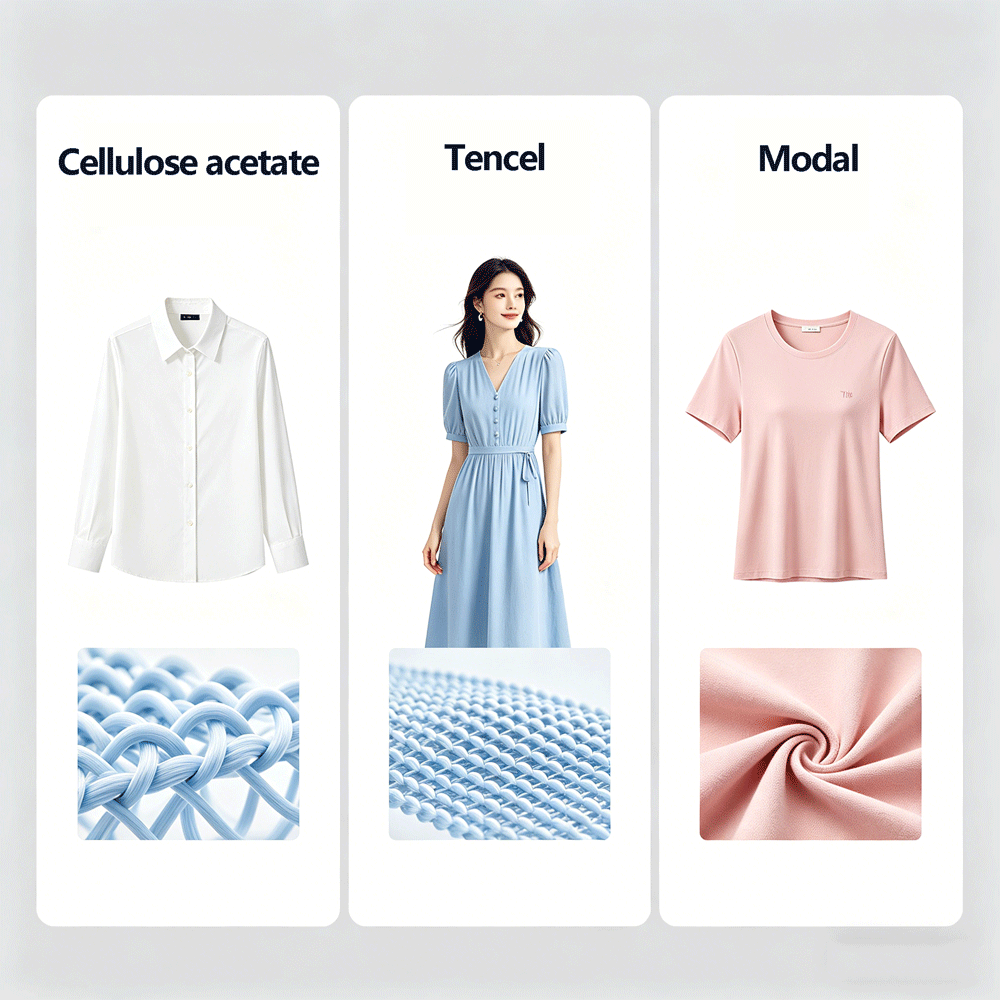
It is made from wood pulp through acetylation reaction to produce cellulose acetate ester, followed by dry spinning. Acetate fiber features a silk-like luster and drape, along with low moisture regain and dimensional stability, making it an ideal material for linings, decorative splicing, and high-sensory fabrics in professional wear.
Made from wood pulp, it is dissolved using a closed-loop organic solvent (NMMO) and produced via the solvent-based wet spinning process. The production process is environmentally friendly, and the fiber itself features high strength, good moisture absorption and a smooth touch. In uniforms, Lyocell is often blended with cotton and polyester to enhance the fabric's skin-friendliness and drape, making it suitable for business workwear that requires both comfort and crispness.
Made from natural wood pulp such as beech wood via a specific high-wet-modulus viscose process, the polymerization degree and wet modulus of cellulose are strictly controlled, enabling it to maintain high strength even in a wet state. Modal fiber is soft and delicate. When blended with cotton or polyester, it is often used in underwear-style workwear or sporty professional uniforms that require high skin-friendliness.
Synthetic Fibers: The Core of Functionality and Durability
Polyester (Polyester Fiber)
Made from purified terephthalic acid (PTA) and monoethylene glycol (MEG) through esterification and polymerization, using either melt direct spinning or chip spinning processes. Polyester offers high strength, wrinkle resistance, and quick-drying properties, making it a foundational fiber for workwear, protective clothing, and uniforms that require frequent washing. Golden Shield uses differentiated polyester filaments and staple fibers in combination with fabric structure designs to achieve functions such as anti-static and moisture-wicking properties.
Recycled Polyester
Produced from waste polyester bottle flakes or polyester waste, which are crushed, cleaned, melted, and then re-spun into recycled PET fiber. It retains the performance characteristics of virgin polyester while significantly reducing the carbon footprint. This material is widely used in eco-friendly uniforms, helping companies meet their sustainability goals.
Nylon (Polyamide Fiber)
Manufactured through the polymerization of caprolactam or nylon salt, followed by melt spinning. Nylon offers the highest abrasion resistance among textile fibers, along with excellent elastic recovery. It is commonly used in high‑durability workwear, outdoor uniforms, and areas of garments that demand high tensile strength, such as elbows and knees.
Spandex (Polyurethane Elastic Fiber)
Produced by polymerizing polyether or polyester with diisocyanate, using a dry spinning process. Spandex has an elongation at break of over 400% and is the key component for imparting elasticity to uniforms. Typically blended with other fibers at 3%–20%, it ensures ease of movement and shape retention in workwear.
Acrylic (Polyacrylonitrile Fiber)
Made from acrylonitrile as the primary monomer (accounting for more than 85%), copolymerized with second and third monomers, and processed via wet or dry spinning. Acrylic offers bulkiness and thermal retention comparable to wool, along with outstanding lightfastness and weather resistance. It is ideal for cold‑weather uniform jackets and workwear used in long‑term outdoor environments.