ما الذي تبحث عنه ؟

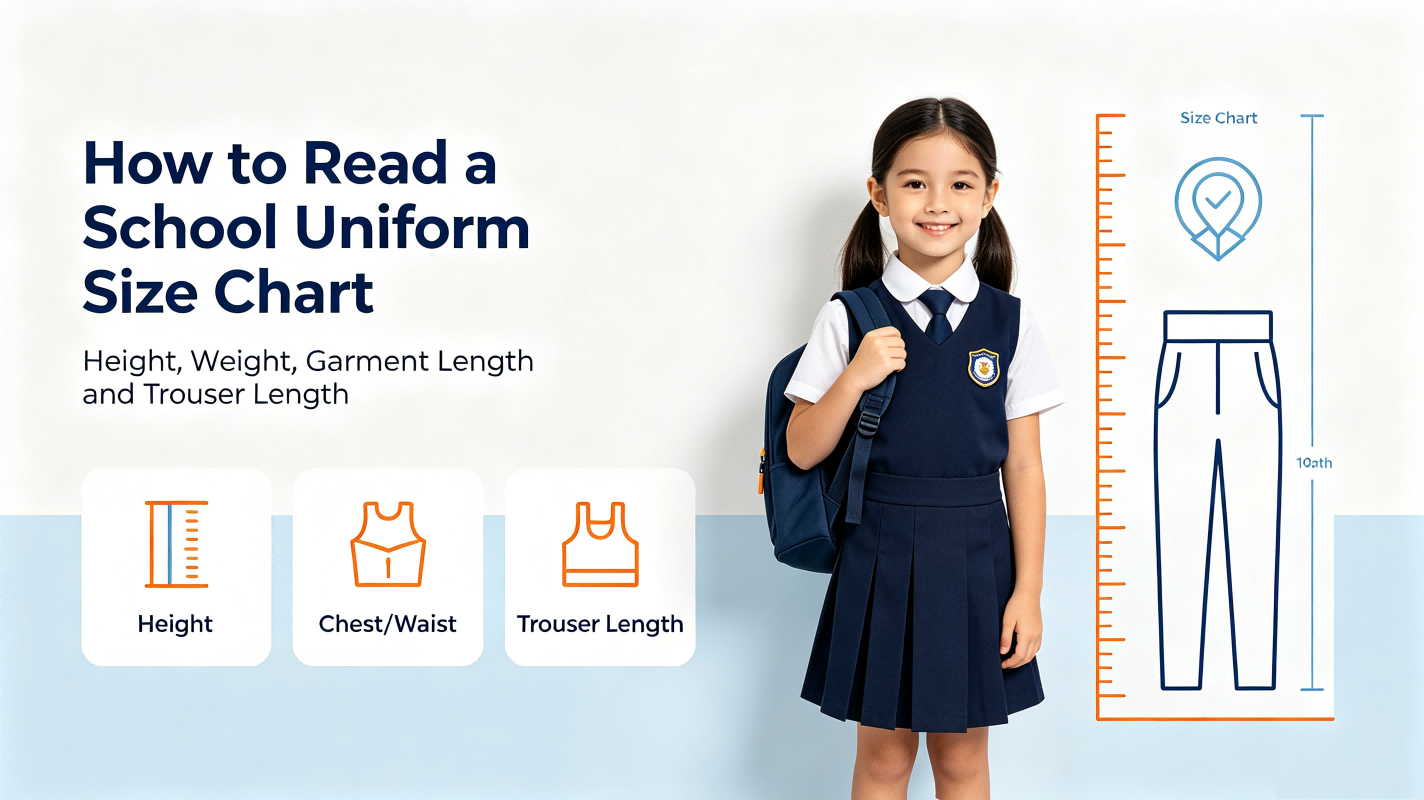
What's the most headache-inducing thing about buying school uniforms for your kid? It's not picking the style, not choosing the colour—it's picking the right size.
Too big, and your child looks like they're wearing a potato sack—sleeves rolled up three times, trouser legs dragging on the floor. Too small, and it's tight across the shoulders after just one term, knees straining, waistband digging in. And the real kicker? School uniforms aren't like regular clothes—you can't just swap them easily. Most schools do bulk orders, so if you get the size wrong, you're stuck with it for a whole term or even a year.
Today we're going to go through school uniform sizing from start to finish—how to read the size chart, how to convert height and weight into garment and trouser lengths, and how to choose for different body types. After reading this, you won't second-guess yourself again.
--------------占位---------------
1. First, understand how school uniform sizes are actually determined
School uniform sizes aren't pulled out of thin air—there's a national standard behind them.
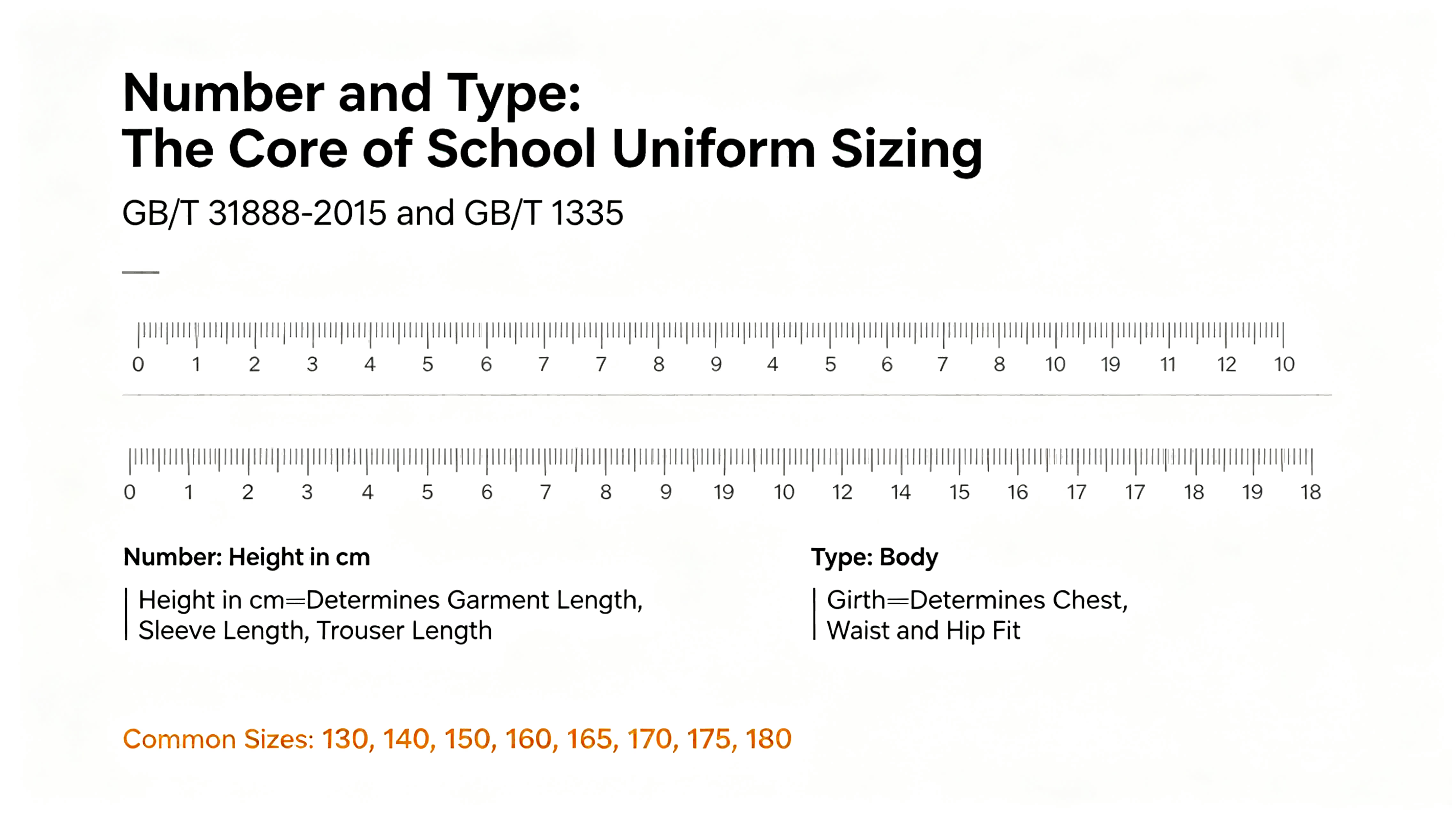
According to GB/T 31888-2015 "School uniforms for primary and secondary school students", sizing should follow the rules in GB/T 1335 or GB/T 6411. In plain English, the core of school uniform sizing is based on two concepts: "number" and "type."
l "Number" refers to height, in centimetres. It determines vertical measurements like garment length, sleeve length, and trouser length.
l "Type" refers to body girth, including chest, waist, and hip measurements. It determines how wide or snug the garment is.
The national standard says that children's clothing heights should be graded in steps of 5 cm, 7 cm, or 10 cm. That's why you usually see sizes like 130, 135, 140, 145, 150, 155, 160, 165, 170, 175, 180—each one corresponds to a height range, paired with matching chest and waist measurements.
--------------占位---------------
2. A quick table to show how sizes match up
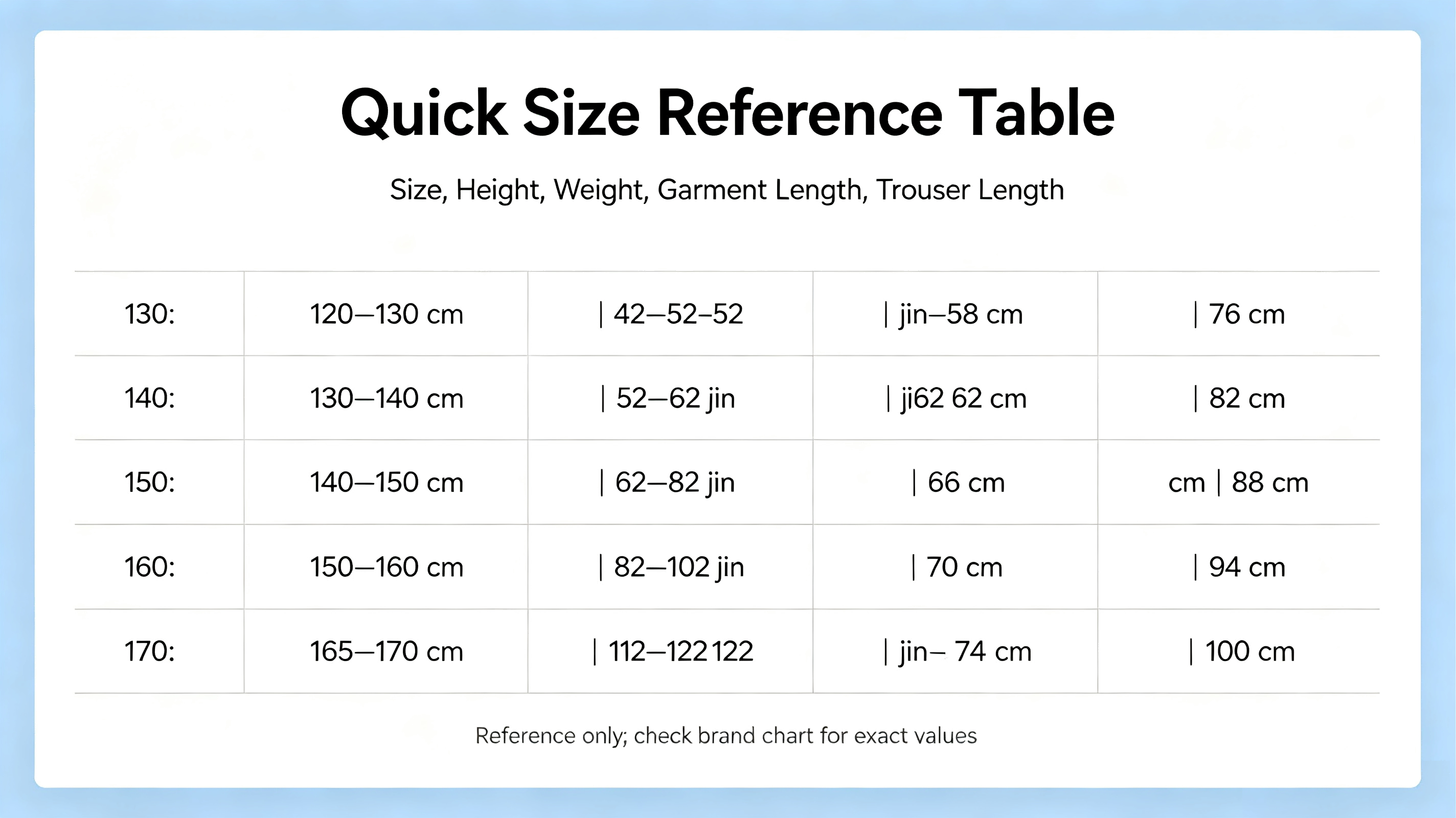
Different manufacturers and different seasons may have slight variations, but most mainstream sizing follows something like this:
Common school uniform size vs. height reference table (for guidance)
As shown in the left figure
(1 jin ≈ 0.5 kg; weights are in Chinese jin as commonly used in local sizing.)
(These are reference values—different brands and styles may vary by 1–3 cm.)
As you can see from the table, size is directly tied to height. A size S typically fits 145–155 cm, M fits 155–165 cm, L fits 165–175 cm, and XL fits 175–185 cm. But these are just guidelines—the final choice depends on your child's build and the garment's cut.
--------------占位---------------
3. Height, weight, garment length, trouser length—how do you convert between them?
A lot of parents ask: is there a formula that tells you exactly what size to buy based on height and weight?
The short answer: no fixed formula, but there are rough rules of thumb.
When choosing a school uniform size, prioritise height first, then weight. Garment and trouser lengths depend mainly on height; chest and waist sizes depend mainly on body shape (whether your child is slim or stocky).
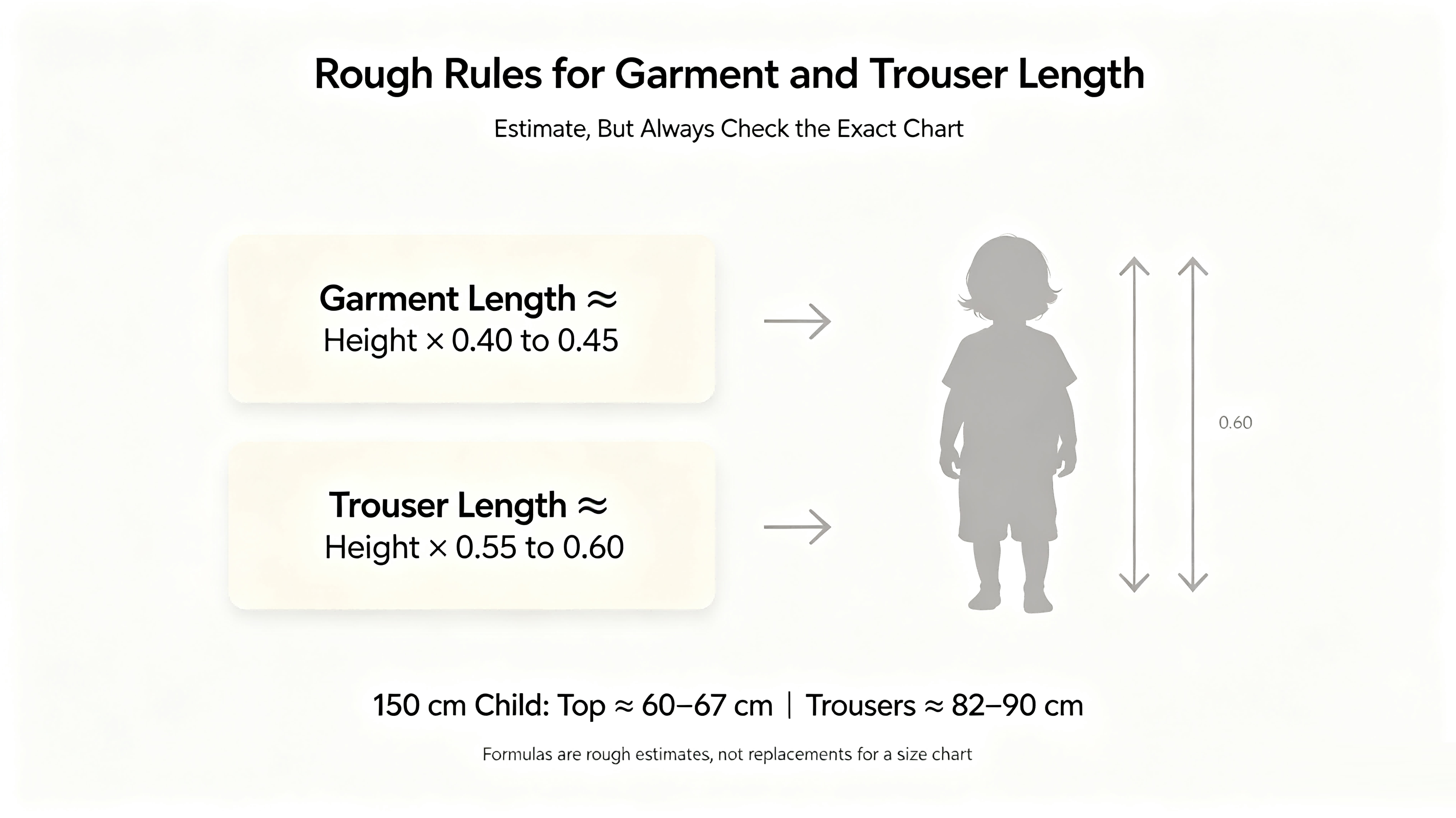
Rough rule for garment length: Top length ≈ height × 0.4 to 0.45. For example, a child who is 150 cm tall would have a top length of roughly 60–67 cm. Looking at the table above, size 150 has a garment length of 66 cm—spot on.
Rough rule for trouser length: Trouser length ≈ height × 0.55 to 0.6. For a 150 cm child, that's about 82–90 cm. The table shows size 150 with an 88 cm trouser length.
But remember, these are just very rough estimates. Different manufacturers and different styles have different cuts—some are more fitted, some more relaxed. The most reliable way is still to check the specific size chart for that particular uniform, not to rely on a formula.
--------------占位---------------
4. Different body types: three simple principles
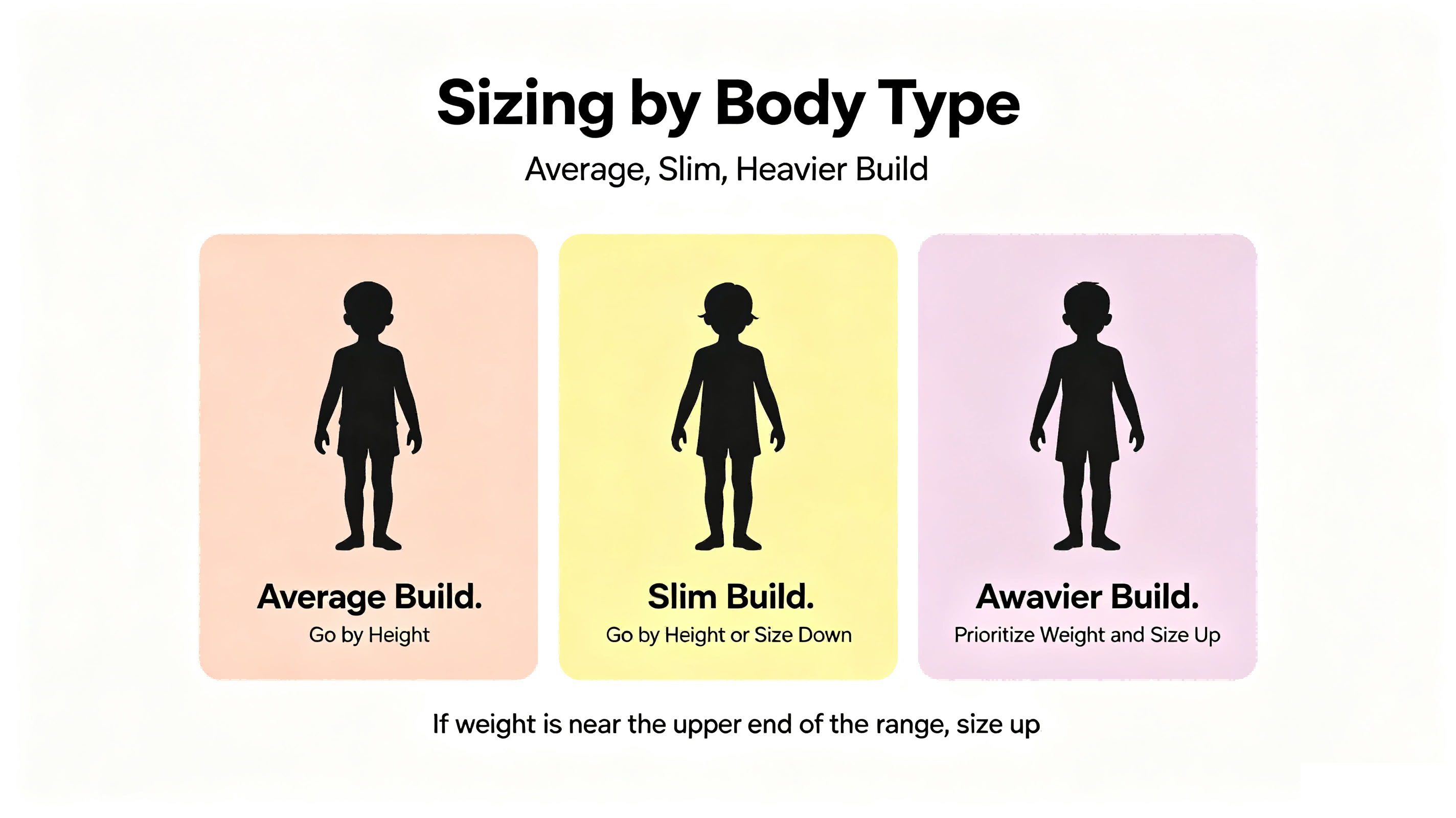
Principle 1: Average build—just go by height
If your child is a fairly average build, just match their height to the "reference height" column on the size chart. For example, if they're exactly 155 cm tall, go for size 155 or 160—size 155 is a snug fit, size 160 is a little roomier and will last a bit longer.
Principle 2: Slim build—go by height, or even size down
A slim child in a size that matches their height may end up looking like they're swimming in it. In that case, consider sizing down by one, or within the same size, pick a style with a slimmer chest and waist. This is especially true for summer uniforms—they're thin and loose, and a size too big just looks sloppy.
Principle 3: Heavier build—go by weight, and size up if needed
For a heavier child, going by height alone will often give you a size that's too tight. Here, prioritise weight over height. If your child's weight is near the upper end of the size chart's range, go up a size. Pay special attention to chest and waist measurements—if the top is tight across the belly or the trousers pinch at the waist, your child will be uncomfortable all day.
--------------占位---------------
5. Different seasons, different grades—different sizing strategies
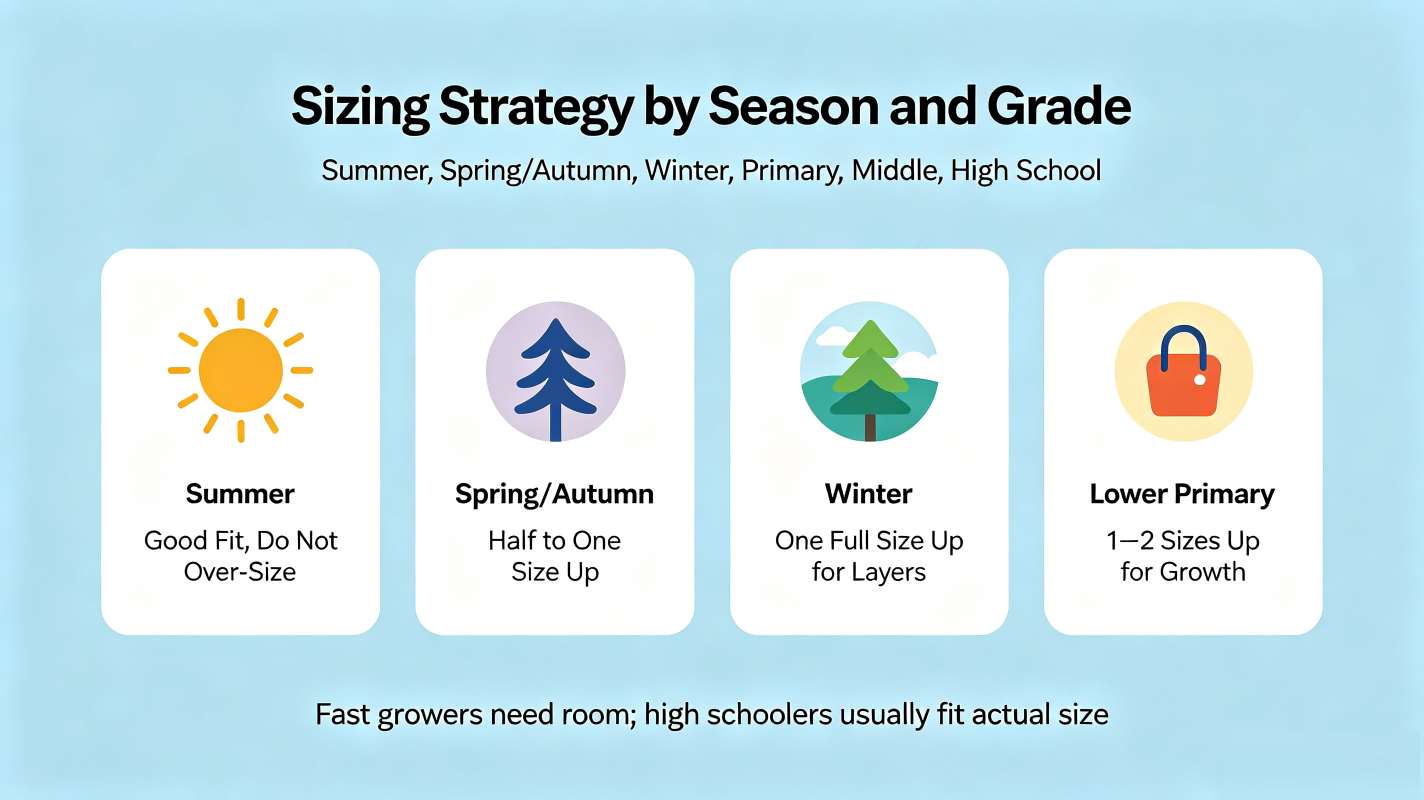
Summer uniforms: go for a good fit, don't size up
Summer uniforms are lightweight—if you buy too big, they look limp and untidy. For short-sleeved T-shirts, the shoulder width should ideally be within about 2 cm of your child's actual shoulder width. In summer, you wear less anyway, so a larger size just looks baggy and unkempt.
Spring/autumn uniforms: size up a little
These go over a base layer, and kids are more active in these seasons. It's fine to go half a size to a full size up from the normal fit. But don't go overboard—if the cuffs and hem are obviously too long, they'll trip or catch on things.
Winter uniforms: leave room for layers
Winter uniforms go over thermal underwear, sweaters, etc., so you need extra space. Size up by one full size to make sure it's not too tight when wearing thicker clothes underneath.
Lower primary (grades 1–3): go 1–2 sizes up
--------------占位---------------
Kids at this age grow the fastest—they can shoot up 5–8 cm in half a year. Many schools actually advise parents to choose 1–2 sizes larger. A common rule of thumb is "height + 10 cm"—for example, a 120 cm child should get size 130.
Upper primary (grades 4–6): aim for a good fit or slightly roomy
Growth tends to slow down a bit, so you can go for a proper fit or just a tiny bit roomy. At this age, body shapes start to vary more, so pay more attention to chest and waist measurements.
Middle school: depends on growth spurts
In the first year of middle school, kids are hitting puberty and growing fast—go a bit looser. By the second and third years, growth slows, so you can go with the actual fit.
High school: choose the actual size
High schoolers are basically done growing—just pick the size that actually fits. No need to leave extra room; a proper fit will last the longest.
--------------占位---------------
6. Don't forget about shrinkage
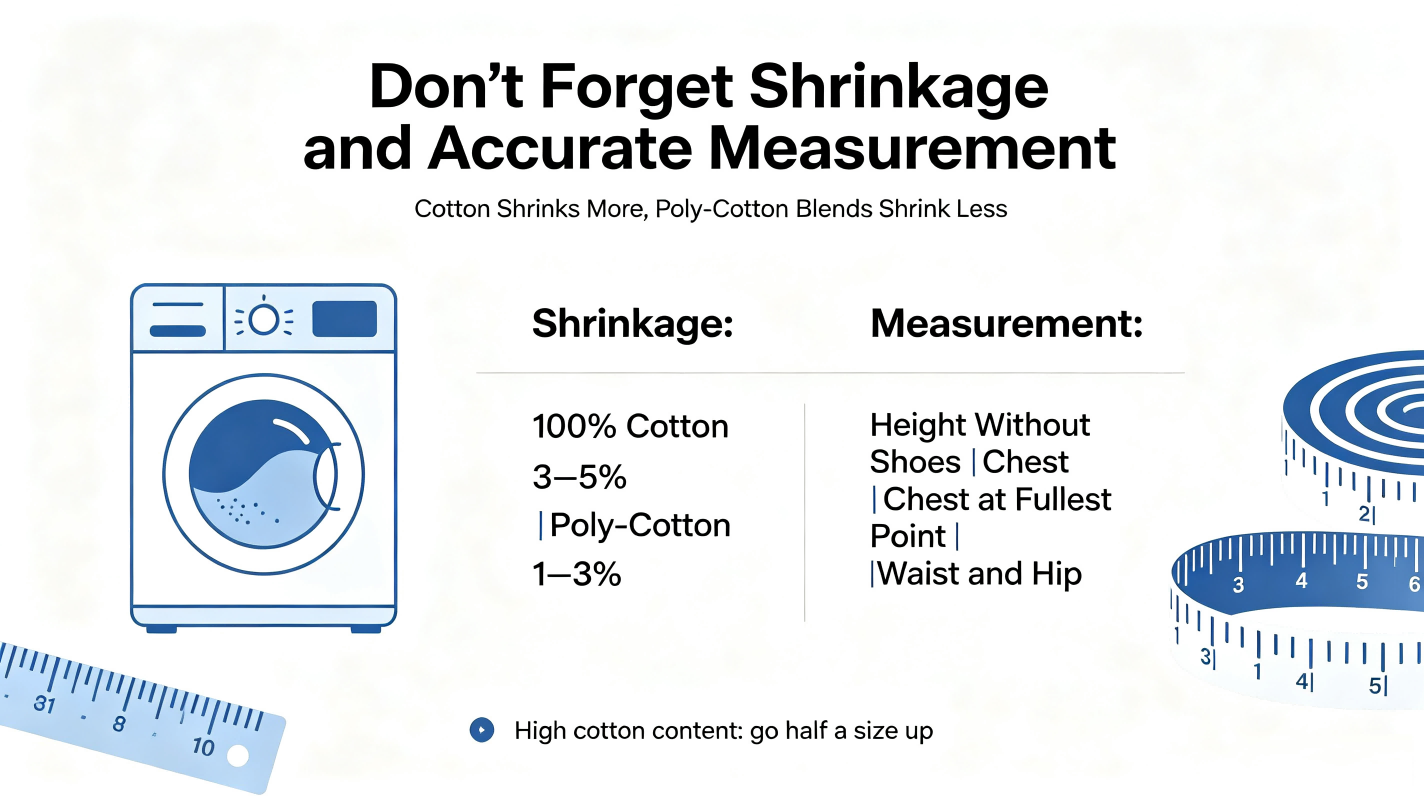
Uniforms shrink a little after a few washes. 100% cotton fabrics tend to shrink 3–5%, while poly-cotton blends shrink 1–3%.
That means a pure cotton uniform with a garment length of 70 cm might end up at 66–68 cm after a few washes. If you bought it just right, after washing it could become a bit tight.
Our advice: If the uniform has a high cotton content, go up half a size to leave room for shrinkage. If it's a low-cotton poly-cotton blend, shrinkage is minimal, so a proper fit is fine.
7. Practical tips for actually buying
First, measure accurately. For height, have your child stand straight against a wall without shoes and measure from the floor to the top of the head. For chest, measure around the fullest part under the armpits.
Second, don't just look at height. Two kids of the same height but with a 5 kg weight difference will look completely different in the same size. Always check the "reference weight" on the chart.
Third, sizes vary between brands. Different manufacturers have different size standards. Some run large, some run small. If it's a school-wide bulk purchase, try to check a sample or the size reference provided by the school.
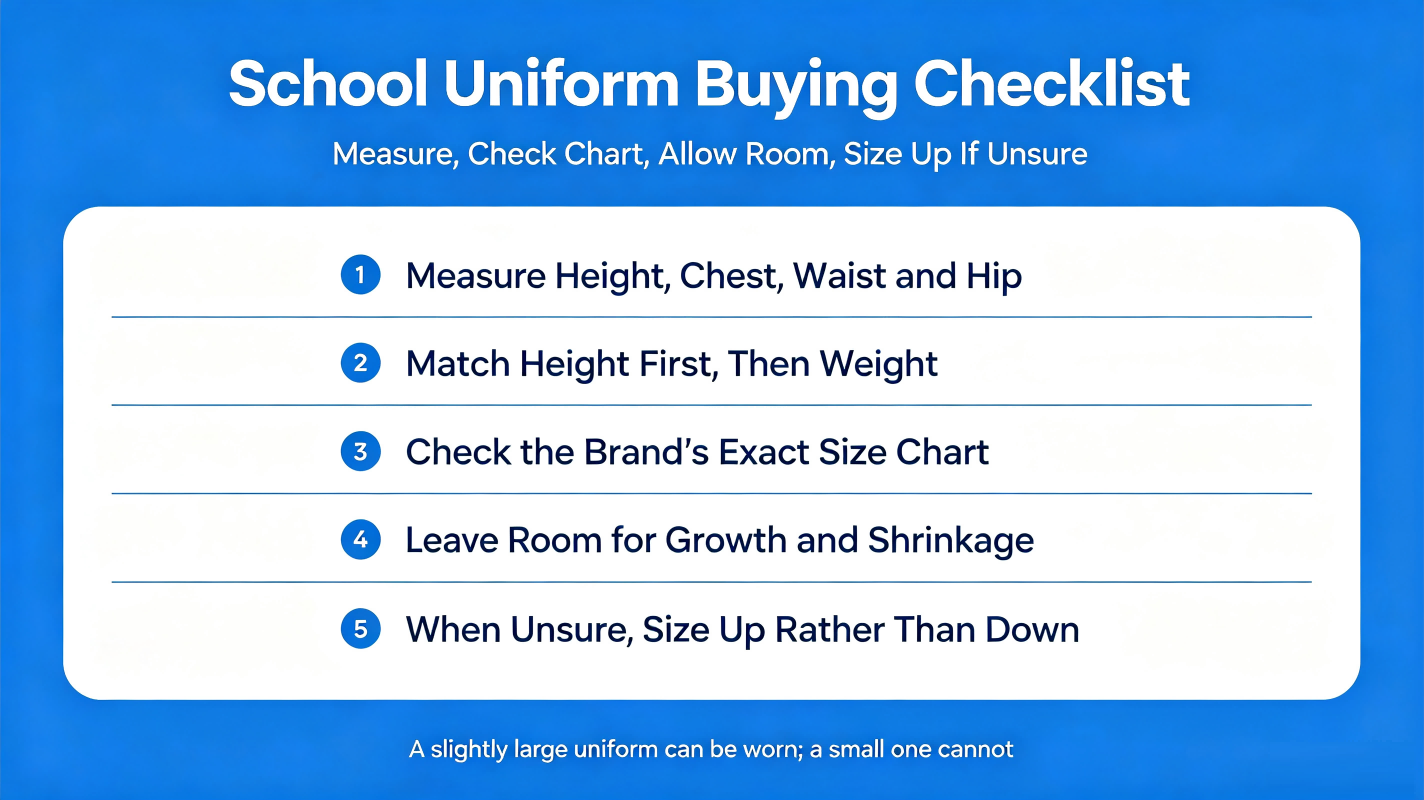
Fourth, if you're really unsure, go bigger rather than smaller. A slightly large uniform can still be worn; a small one is completely unusable. Especially when it's a school order with no exchanges, it's better to size up than to end up with something too tight.
One last honest word
School uniform sizing can seem complicated—height, weight, chest, waist, shrinkage, growth rates … but it's actually simple if you break it down: measure accurately, read the chart carefully, and leave a little wiggle room.
There's no "perfect" size—it all depends on your child's real situation. For average builds, go by height; for heavier builds, go by weight; for fast growers, leave room; for slow growers, go with the fit. Once you've got that down, next time you'll know exactly what to pick. No more guessing.