ما الذي تبحث عنه ؟

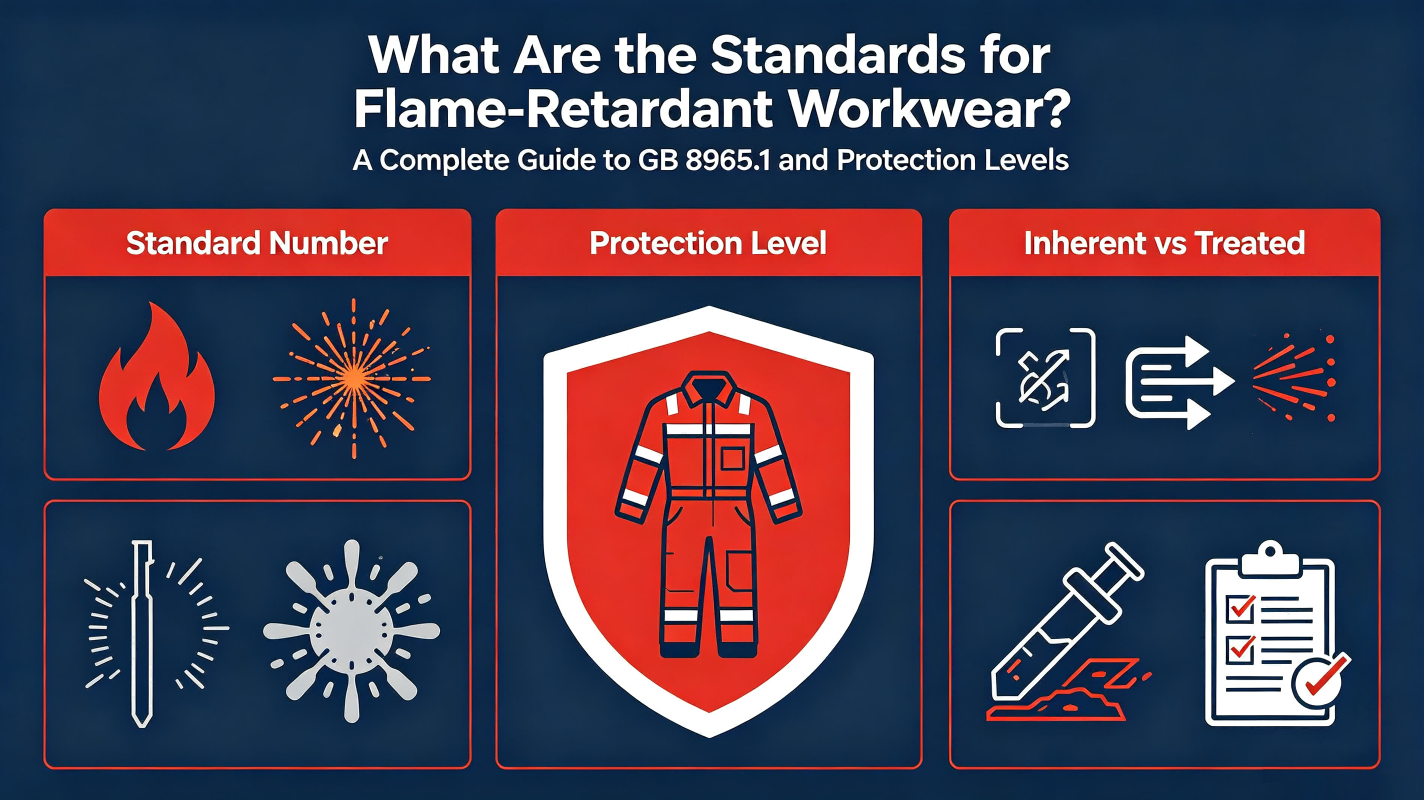
1. What is GB 8965.1? Why does this standard exist?
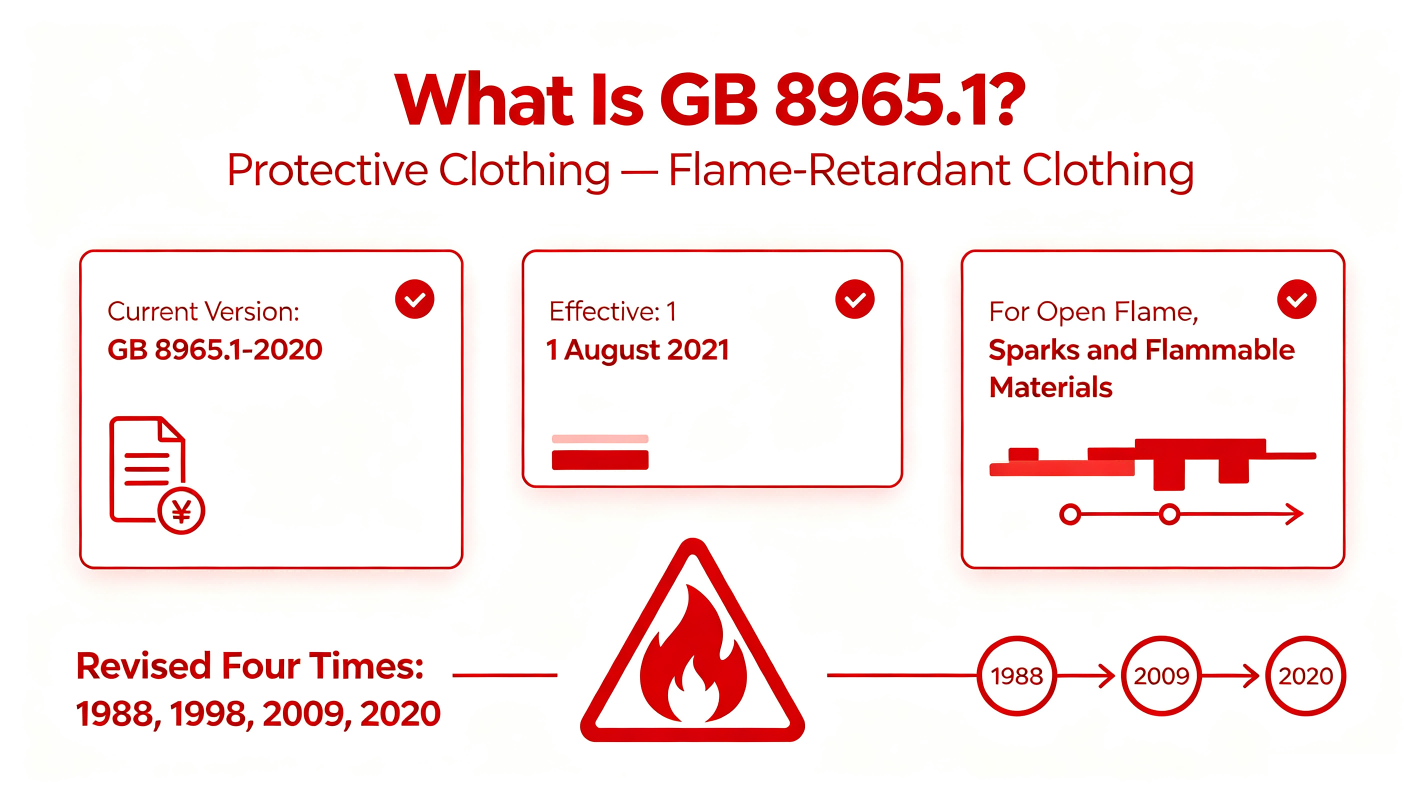
The full title of GB 8965.1 is "Protective clothing – Flame-retardant clothing." It is China's mandatory national standard for flame-retardant clothing. The current version is GB 8965.1-2020, issued on 23 July 2020 and effective from 1 August 2021, replacing the 2009 version.
This standard applies to flame-retardant clothing worn in workplaces with open flames, sparks, or flammable materials with flashover risks. In plain terms, if the work environment has flames, high heat, or explosion risks, this is the standard that governs what you wear.
The national standard for flame‑retardant clothing has been revised four times—starting with GB 8965 in 1988, revised in 1998, changed to GB 8965.1‑2009 in 2009, and revised again in 2020 to the current GB 8965.1‑2020. The standard keeps getting stricter because the emphasis on worker safety keeps increasing.
2. The biggest change: from three levels to two
This is the most core change in the new standard, and something every buyer must know.
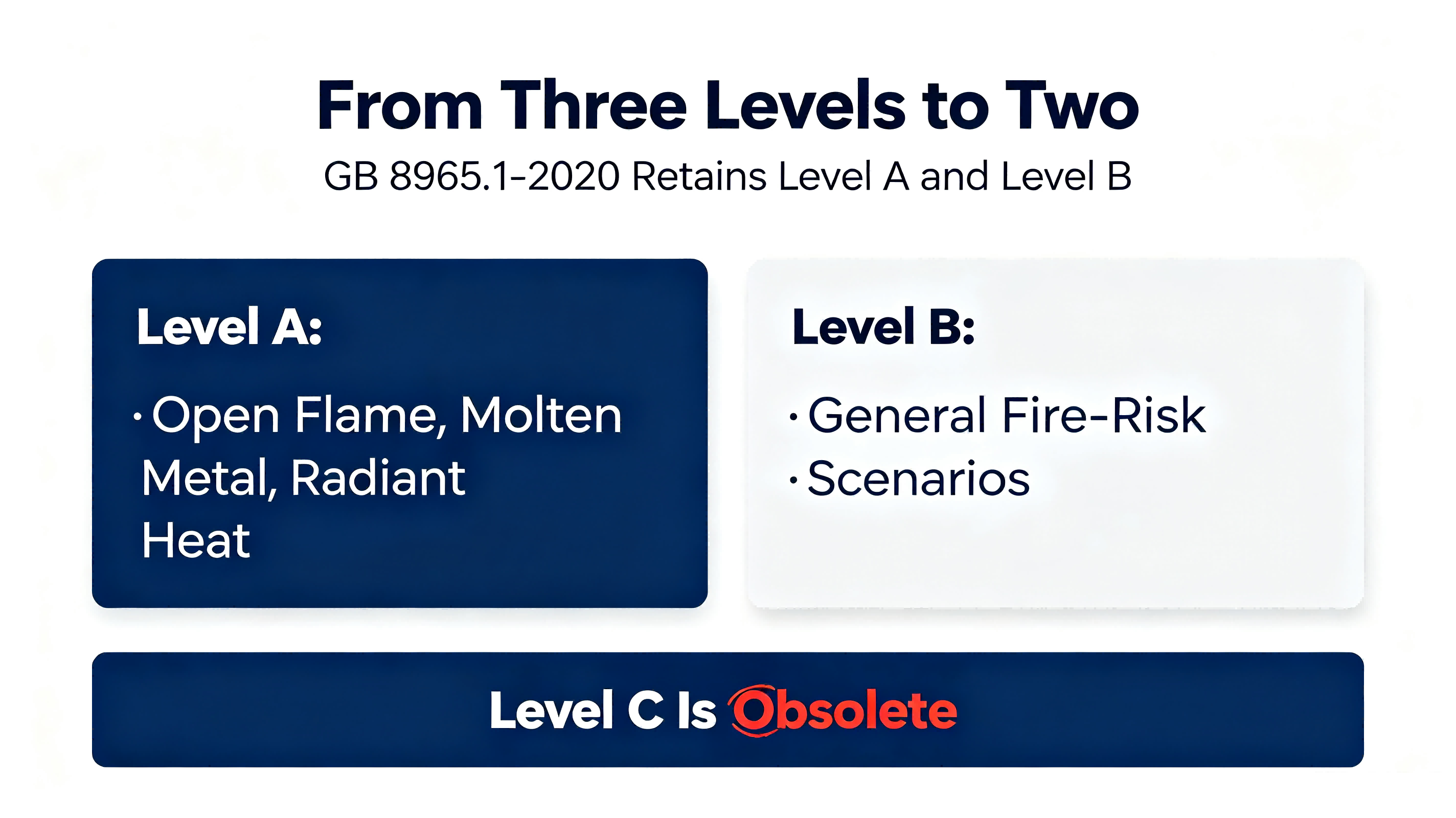
The old standard (GB 8965.1‑2009) divided flame‑retardant clothing into three levels: A, B, and C. The 2020 version abolished Level C, retaining only Level A and Level B.
Level A: for environments with open flames, sparks, operations near molten metal, radiant heat, and convective heat. Higher protection requirements, with stricter indicators for char length, afterflame time, etc.
Level B: for general fire-risk work scenarios. Protection requirements are slightly lower than Level A, but must still meet the basic flame-retardant performance requirements of the national standard.
The new standard removed the definition of "applicable occasions" for each level and instead classifies by garment protective capability. This means when purchasing, you can't just look at the level name—you also need to check the specific performance indicators.
Important note: Level C flame-retardant clothing that previously obtained safety mark certification under the old standard no longer complies with the new standard. Companies holding Level C safety mark certificates need to apply to change Level C to Level B. If a supplier is still offering "Level C flame‑retardant clothing," they are following an obsolete standard, and the product's compliance is questionable.
3. Core technical indicators: understand these numbers and you understand flame‑retardant clothing
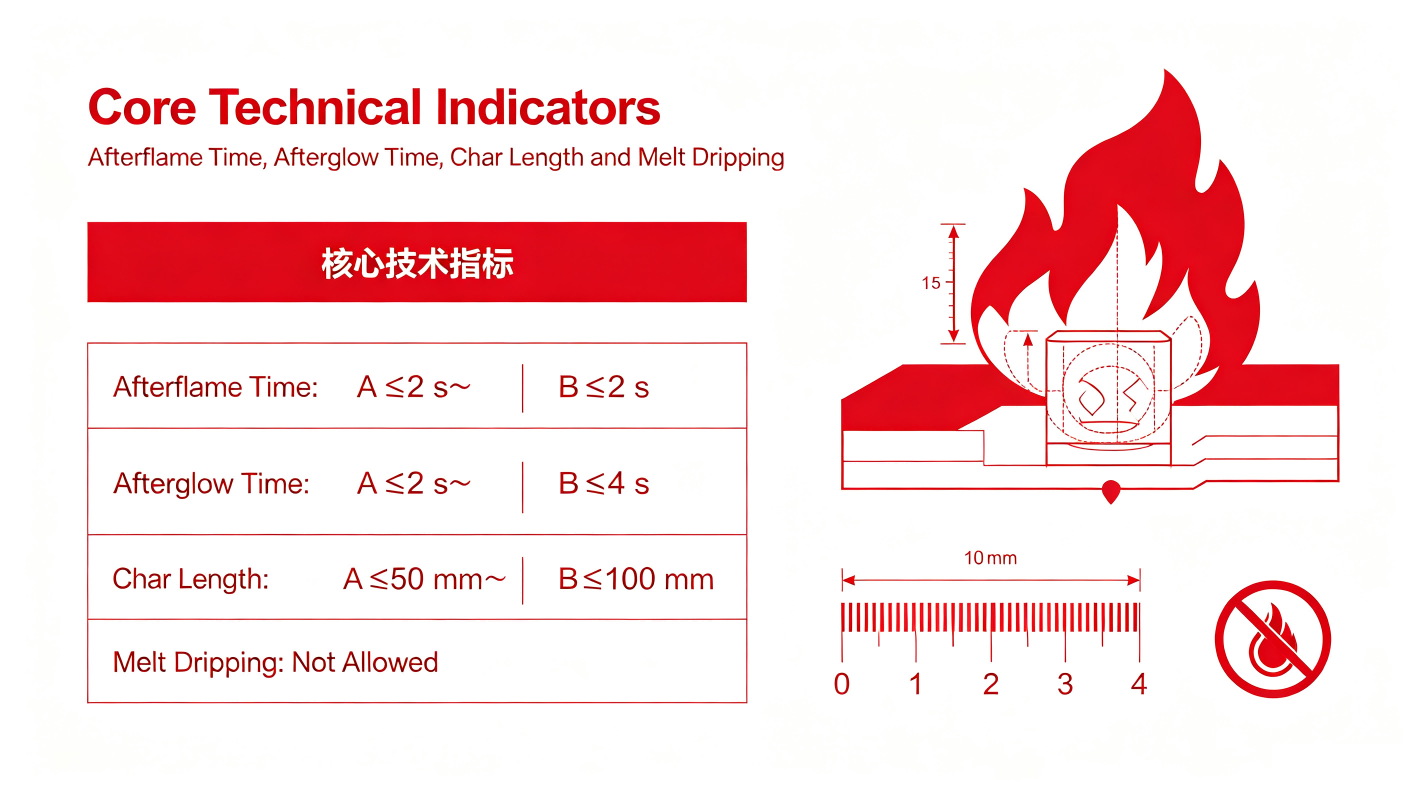
The core performance indicators for flame‑retardant clothing revolve around afterflame time, afterglow time, char length, and melt dripping. Let's explain these first:
Afterflame time: the time the fabric continues to burn with flame after the ignition source is removed. The shorter, the better – ideally 0 seconds, meaning it self‑extinguishes immediately.
Afterglow time: the time the fabric continues to glow, smoulder, or burn without flame after the ignition source is removed. Also shorter is better.
Char length: under standard test conditions, the length of fabric destroyed by the flame. Shorter means better flame retardancy.
Melt dripping: when synthetic fabrics melt at high temperatures, molten droplets fall. This is the most dangerous situation—droplets sticking to the skin cause deeper, more severe burns than the flame itself. A qualified flame-retardant garment must have no melting and no dripping.
According to GB 8965.1-2020, the main performance requirements are:
| Indicator | Level A | Level B |
| Afterflame time | ≤2 s | ≤2 s |
| Afterglow time | ≤2 s | ≤4 s |
| Char length | ≤50 mm | ≤100 mm |
| Melt dripping | Not allowed | Not allowed |
As the table shows, Level A and Level B have the same requirement for afterflame time (both ≤2 s), but Level A is significantly stricter on afterglow time and char length—afterglow time is only half that of Level B, and char length is also half. That's the gap in protective capability.
4. Inherent flame retardancy vs. treated flame retardancy: double the price, several times the lifespan
This is the most easily overlooked issue in flame-retardant clothing procurement, yet it has the biggest impact on the cost of ownership.
Flame‑retardant fabrics are divided into two main types by processing method: inherent flame‑retardant fabrics and treated flame‑retardant fabrics.
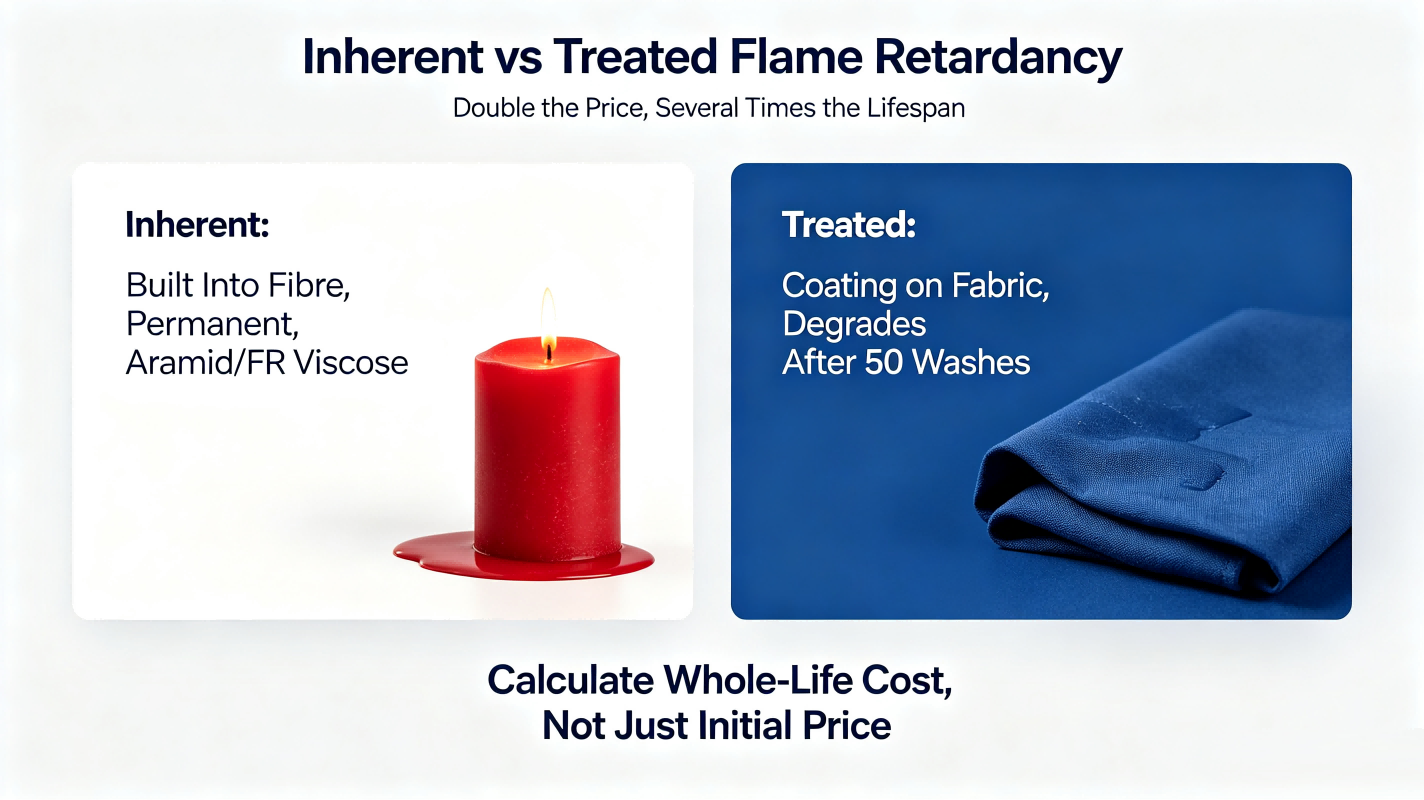
Inherent flame‑retardant fabric, also called permanent flame‑retardant fabric. The flame retardant is added during the fibre spinning process and is fused with the fibre. Think of it like making a red candle—the red is mixed into the wax, not painted on the surface. Common inherent flame-retardant fibres include aramid (Nomex, Kevlar), flame-retardant viscose, and pre-oxidised acrylic. This type of fabric's flame retardancy is permanent—no matter how many times it's washed, the flame-retardant effect does not degrade, and it lasts until the fabric wears out.
Treated flame-retardant fabric is made by applying coatings and auxiliaries during dyeing and finishing to ordinary fabric (usually cotton or poly-cotton). It's like painting a fireproof coating on a candle—it works well when fresh, but washes off over time. Generally, treated flame-retardant fabric shows significant degradation after 50 standard washes.
The difference in procurement cost is also clear. Treated flame‑retardant fabric costs less; inherent flame‑retardant fabric costs more, and permanent flame‑retardant fabric must be woven from 100% flame‑retardant fibres and cannot be blended with other fibres. Treated flame retardants have low cost but short life; inherent flame retardants have higher upfront cost but lower long-term cost of ownership—because they don't need frequent replacement.
5. How to choose for different industries? Four typical scenarios
The core principle for selecting flame-retardant clothing is determining the level and fabric based on the actual risks of the work environment.
Scenario 1: Welding and gas cutting
Facing not just open flames but also large amounts of high-temperature spatter. The "Standards for the Provision of Labour Protection Equipment (Trial)" explicitly states that welders and other workplaces with molten metal splatter should be equipped with welding workwear. It's recommended to choose Level A inherent flame‑retardant fabric, preferably aramid or aramid blends, with a weight of 260–300 gsm.
Scenario 2: Petrochemicals and refineries
Flash fire and explosion risks, plus possible static. For Zone 0 and Zone 1 explosive hazard locations, flame‑retardant workwear with anti‑static performance should be provided. It's recommended to choose Level A inherent flame‑retardant fabric and confirm that anti‑static performance also meets standards.
Scenario 3: Metallurgy, casting, furnace operators
High-temperature radiation and molten metal splatter. Thermal operation workers, furnace operators, and other workers in workplaces with open flame radiation should be equipped with flame‑retardant workwear with good thermal insulation and heat radiation resistance. It's recommended to choose Level A inherent flame-retardant fabric and pay attention to thermal protective performance (TPP value).
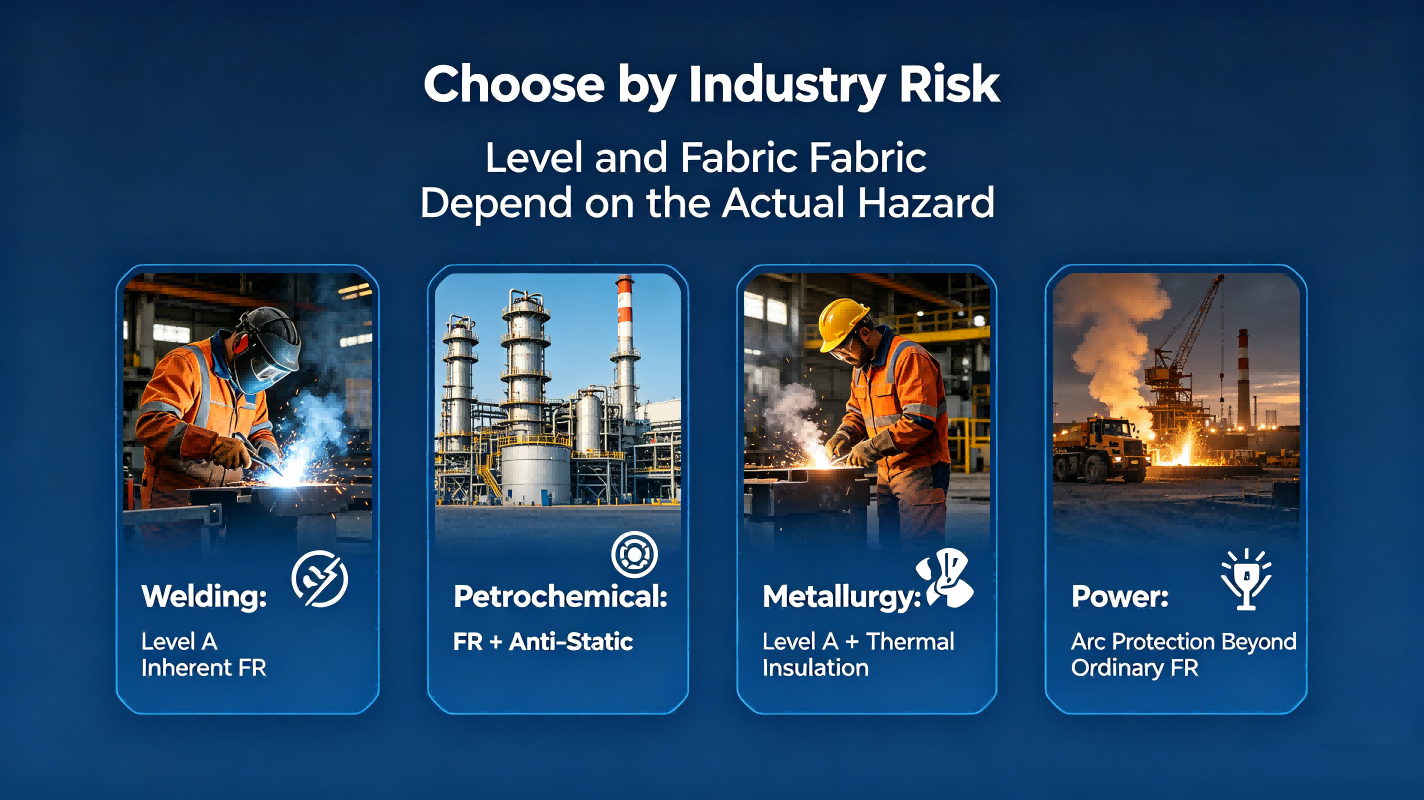
Scenario 4: Power industry
Arc flash is the main risk. Live-line work requires conductive suits, while general power inspection and maintenance roles should be equipped with Level A or Level B flame-retardant clothing. Special attention should be paid to the fabric's arc protection performance—this goes beyond ordinary flame-retardant clothing and falls under the arc protective clothing (APC) standard system.
6. Procurement in practice: five inspection actions
Now that you know the standard, here's the practical part. When purchasing flame-retardant clothing, carry out these five inspection actions:
Action 1: Check the standard number and level marking
A compliant flame-retardant garment tag should clearly state the execution standard number (GB 8965.1-2020) and the protection level (Level A or Level B) . If it only says "flame-retardant" without a level, or shows an old standard number, be suspicious. Level C flame-retardant clothing is obsolete—if you see "Level C," you can skip it entirely.
Action 2: Check the fabric composition and flame-retardant type
Ask the supplier clearly: is it inherent or treated flame retardancy? What is the fabric composition? If it's aramid, flame-retardant viscose, or other inherent flame-retardant fibres, you can feel confident. If it's "100% cotton with treated flame retardancy," ask how many washes the flame retardancy will survive.
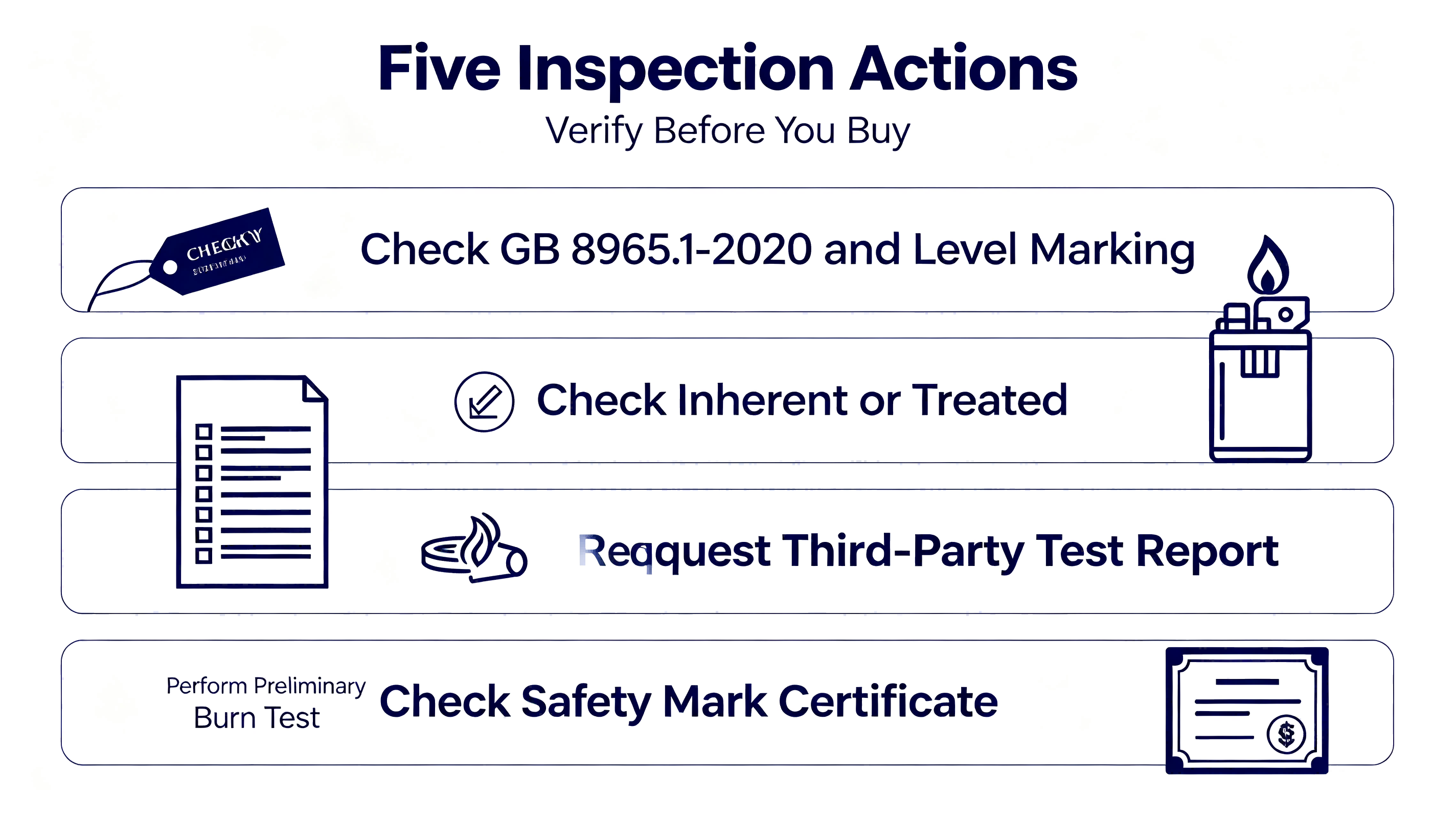
Action 3: Request a third-party test report
Ask the supplier for a test report from a nationally accredited third-party testing institution. When reviewing the report, pay attention to three things: whether the testing standard is based on the latest GB 8965.1‑2020; whether post‑wash flame‑retardant performance was tested (not just initial state); and whether the fabric model in the report matches the actual supply.
Action 4: Simple burn test
If conditions permit, briefly hold a lighter to the edge of the fabric for 3 seconds. A qualified flame-retardant fabric should self-extinguish when the flame is removed, with no melt dripping. If it keeps burning or leaves hard melted beads, it fails. This test is only a preliminary screening and cannot replace professional testing.
Action 5: Check the safety mark certificate
Flame-retardant clothing is specialised labour protection equipment and requires a Special Labour Protection Product Safety Mark (safety mark) . You can ask the supplier for the safety mark certificate and verify the certificate number and validity period.
7. Common misconceptions: the pitfalls buyers fall into most easily
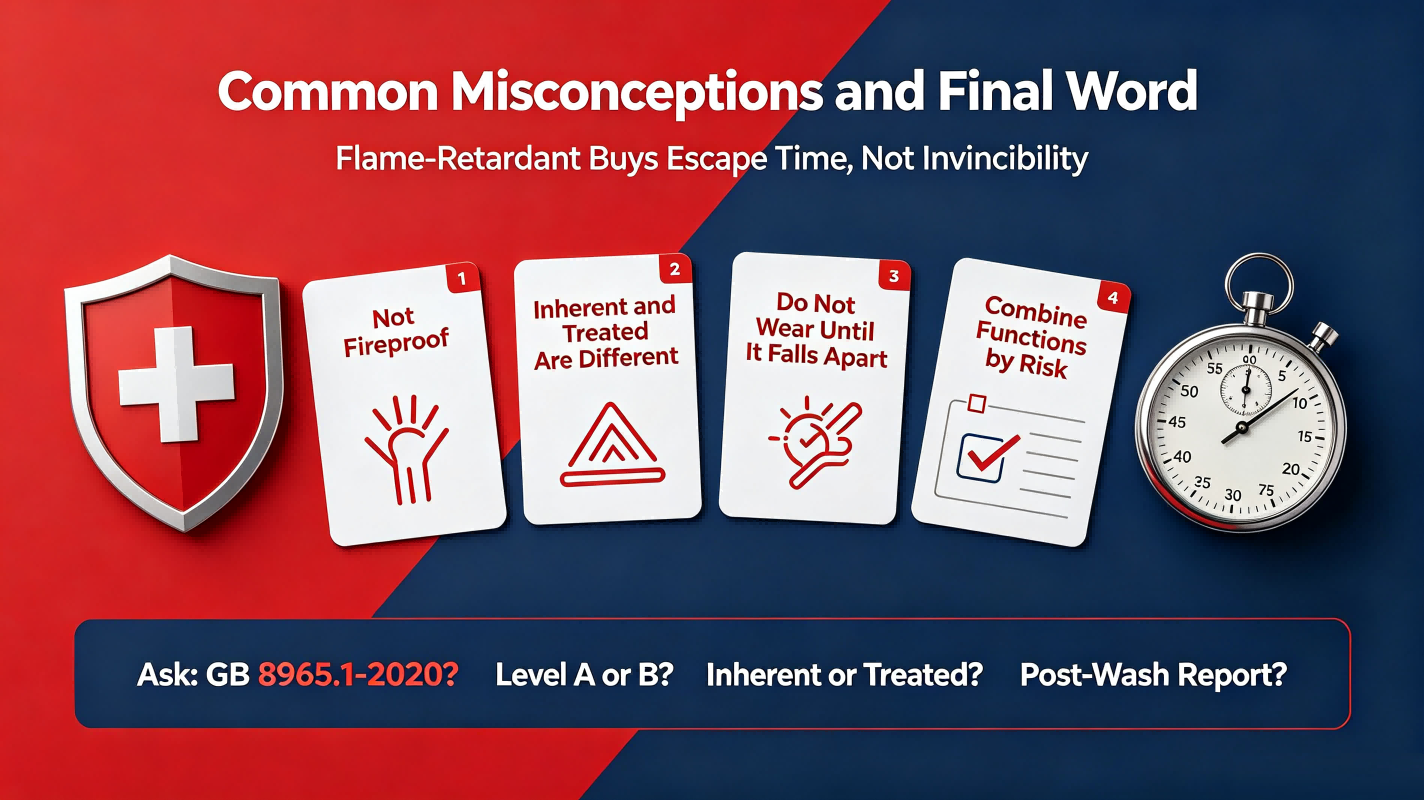
Misconception 1: "Flame‑retardant clothing is fireproof – wearing it means you're safe."
Flame‑retardant clothing's job is to delay burning and buy escape time – it's not "fireproof clothing." A qualified flame‑retardant garment can reduce the depth of flame burns by about 80%, buying the wearer more than 10 seconds of escape time. But it won't let you stand in a fire unharmed. The correct use is – evacuate immediately in a fire; the flame‑retardant clothing buys you a precious escape window.
Misconception 2: "Treated and inherent flame retardancy are roughly the same."
Double the price, several times the lifespan. Treated flame-retardant fabric degrades noticeably after 50 washes; inherent flame-retardant fabric doesn't degrade no matter how many washes. If workwear needs frequent washing (say, two or three times a week), treated flame‑retardant fabric may fail within six months. When purchasing, calculate whole-life cost, not just the initial purchase price.
Misconception 3: "Flame-retardant clothing can be worn until it falls apart."
Flame-retardant performance degrades with washing and wear, especially for treated flame-retardant fabrics. It's recommended to send treated flame-retardant clothing for testing after 30 to 40 washes to confirm whether flame-retardant performance still meets the standard. While inherent flame-retardant clothing's flame retardancy doesn't degrade, the fabric's mechanical properties (like seam strength and tear strength) decline with wear, so regular inspection is still needed.
Misconception 4: "Having flame-retardant function is enough."
Flame-retardant clothing isn't a cure-all. Petrochemical roles need flame-retardant + anti-static; locations with flammable liquids need flame-retardant + liquid-repellent—otherwise, the workwear absorbs flammable liquid and loses its flame retardancy; locations with corrosive chemicals need flame-retardant + chemical protection; high-humidity environments need flame-retardant + waterproof. When purchasing, always combine protective functions according to the actual risks of the job.
A final honest word
GB 8965.1‑2020 is a national standard for flame‑retardant clothing, filled with afterflame time, char length, and thermal protective performance. For buyers, you don't need to memorise every number, but you do need to remember three things:
First, flame-retardant clothing comes in Level A and Level B—Level C is obsolete. Level A is for high-risk scenarios like open flames and molten metal; Level B is for general fire-risk scenarios. Skip Level C products entirely.
Second, inherent and treated flame retardancy are two different things. Inherent doesn't degrade no matter how many washes; treated degrades noticeably after 50 washes. For roles with frequent washing, choose inherent.
Third, flame-retardant clothing is specialised labour protection equipment, not ordinary workwear. Check the standard number, check the level, check the test report, check the safety mark certificate—do these four checks, and you'll filter out most inferior products.
Next time a supplier says, "This is flame-retardant," ask them directly: "Does it comply with GB 8965.1-2020? Is it Level A or Level B? Inherent or treated? Can I see the post-wash flame-retardant performance report after 50 washes?" – being able to ask those questions already makes you more professional than most buyers.