ما الذي تبحث عنه ؟


When buying nurse uniforms, many people flip over the hang tag to check the fabric composition—how much cotton, how much polyester. But there is another line on the tag that deserves to be read first, yet is most easily overlooked: "Safety category: Class B."
What does this line mean? Why must nurse uniforms be Class B? What exactly does Class B govern?
Today we're going to explain GB 18401—this mandatory national standard, especially its Class B requirements—from start to finish. It is not a "recommendation"; it is a baseline—the basic threshold for whether a nurse's uniform can be worn by a person at all.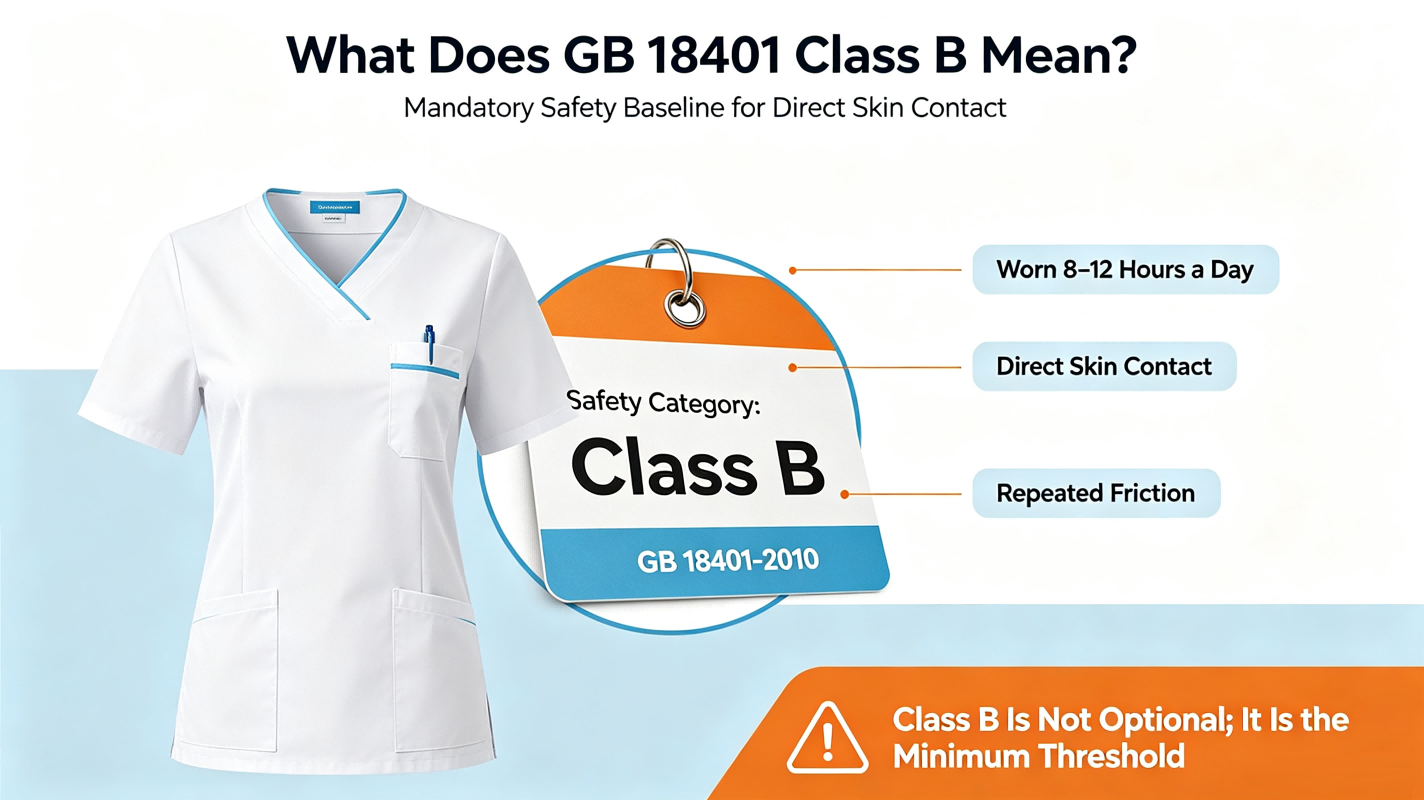
1. What is GB 18401? Why is it "mandatory"?
The full title of GB 18401 is "National General Safety Technical Code for Textile Products." It does not govern whether fabric is comfortable or durable—it governs whether textiles pose a basic hazard to human health. The current version is GB 18401-2010, issued and implemented in 2011. It is a mandatory national standard—if it fails to comply, it cannot be produced or sold.
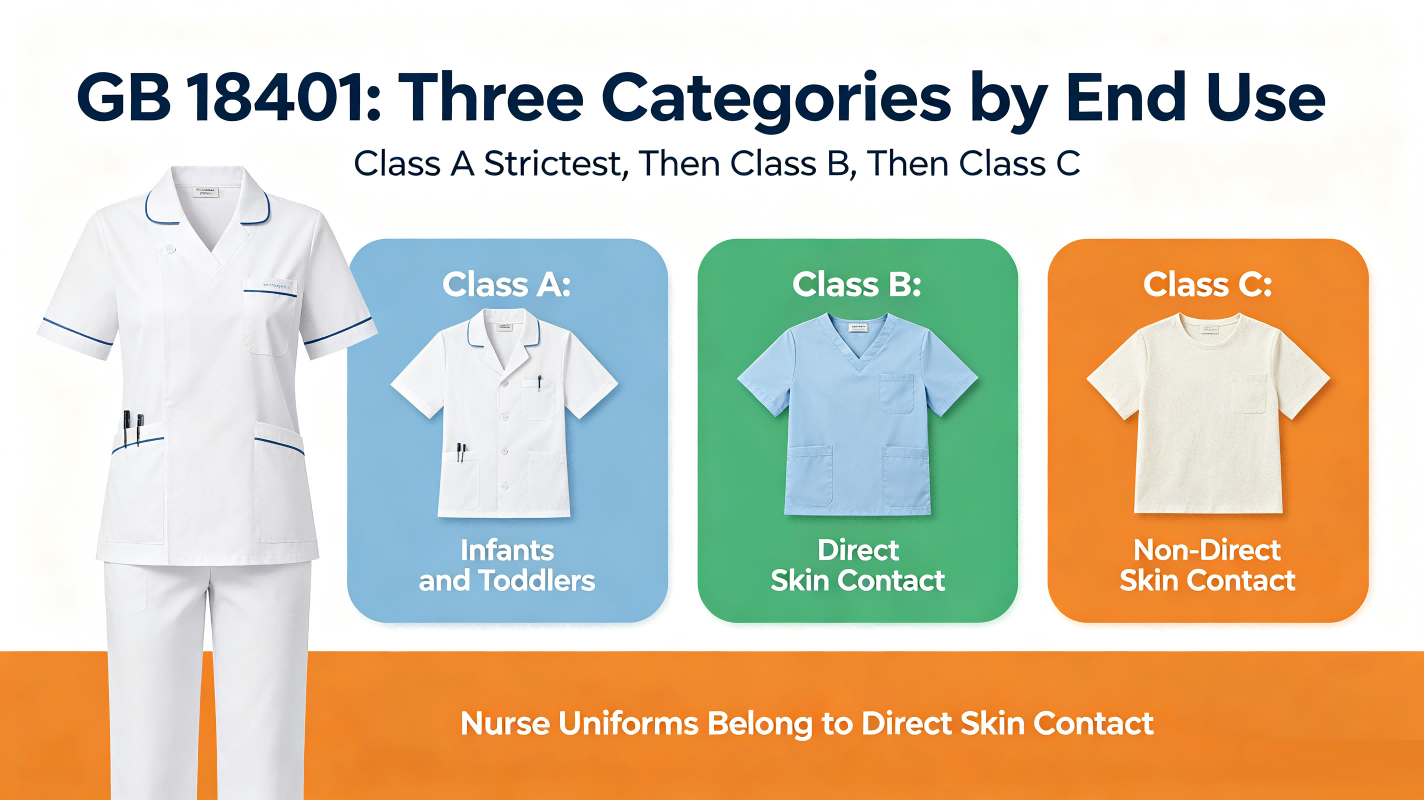
This standard divides textile products into three categories according to end use:
Class A has the strictest requirements, followed by Class B, with Class C being the most lenient. The earlier the category, the tighter the limits on formaldehyde, pH value, colour fastness, and other indicators, and the greater the safety margin.
2. Why must nurse uniforms be Class B, not Class C?
The answer is straightforward: nurse uniforms are products in direct contact with skin.
Nurse uniforms are worn 8 to 12 hours a day, with most of their area against the skin, and they also undergo repeated friction against the skin when the wearer bends, raises their arms, or walks quickly. According to the classification logic of GB 18401, the minimum safety category corresponding to this type of use is Class B.
Actual hospital procurement also locks this in. The nurse uniform procurement announcement from Changjiang Shipping General Hospital explicitly requires "Safety: complies with GB 18401 Class B; formaldehyde, pH value, and colour fastness meet the standard." A nurse uniform tender parameter in Henan also states: "Mandatory safety standard: complies with GB 18401-2010 Class B; formaldehyde ≤75 mg/kg, pH 4.0–8.5, no odour, prohibited decomposable carcinogenic aromatic amine dyes." In the procurement of scrub suits and short-sleeve nurse uniforms, the requirement is "GB 18401-2010 Class B (products in direct contact with skin)" also appears repeatedly.
If a nurse uniform is labelled Class C, what does that mean? It means its formaldehyde limit is 300 mg/kg – four times the Class B limit. A garment worn against the skin 8 to 12 hours a day and subjected to repeated friction, made to the safety standard of an outer coat – that is logically untenable.
3. What exactly does Class B govern? Five core indicators
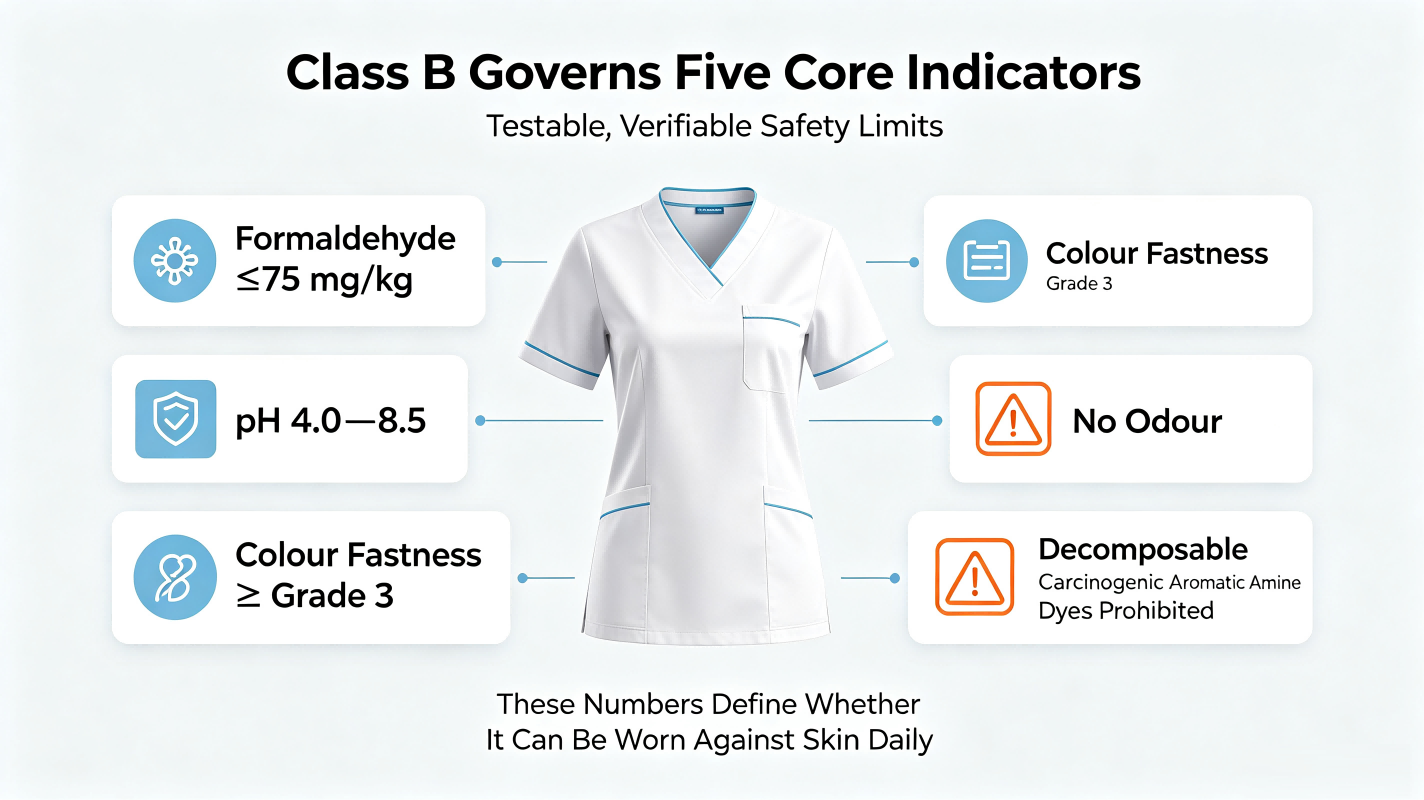
Class B is not an empty phrase – it corresponds to five testable, verifiable indicators.
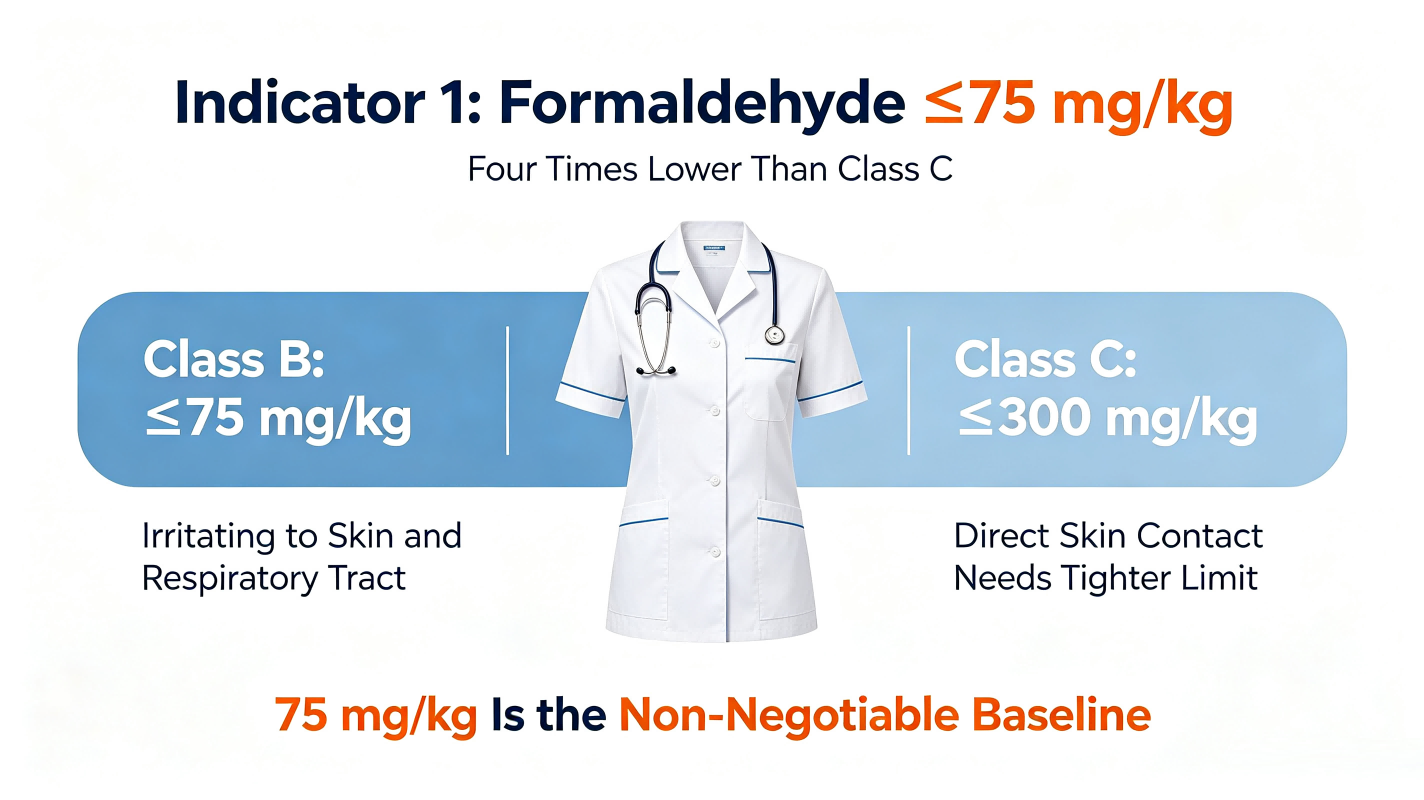
Indicator 1: Formaldehyde content ≤ 75 mg/kg
Formaldehyde may remain in textiles as an auxiliary agent from dyeing and finishing. The permitted upper limit for Class B is 75 mg/kg, while Class C is 300 mg/kg – a full fourfold difference. Formaldehyde is irritating to the skin and respiratory tract. Since nurse uniforms are worn against the skin, this indicator directly relates to nurses' skin health.
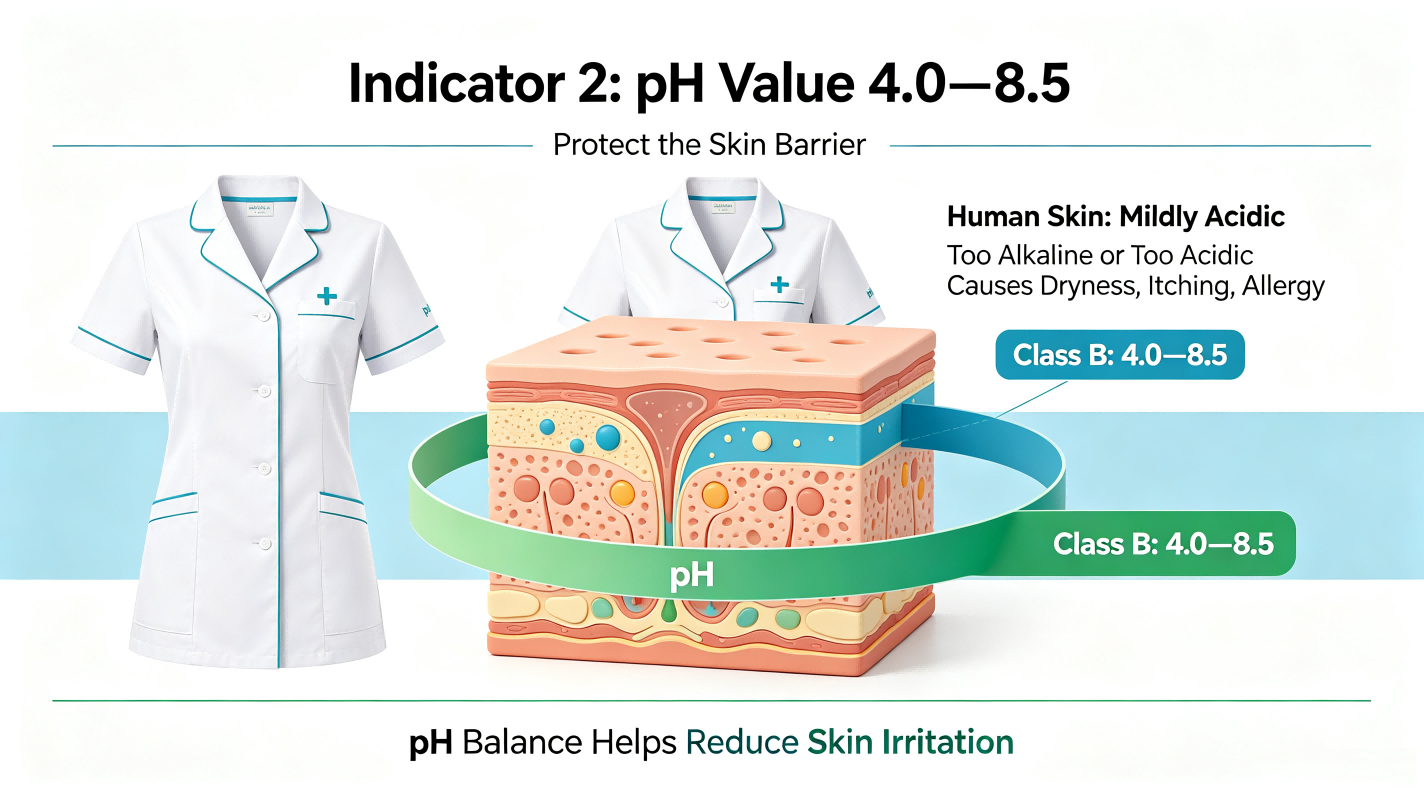
Indicator 2: pH value 4.0–8.5
Human skin surface is mildly acidic – a natural barrier. If fabric pH is too alkaline or too acidic, it destroys this barrier, causing dryness, itching, and even allergies. Class B frames pH between 4.0 and 8.5, with the aim of making the fabric as gentle as possible when in contact with skin.
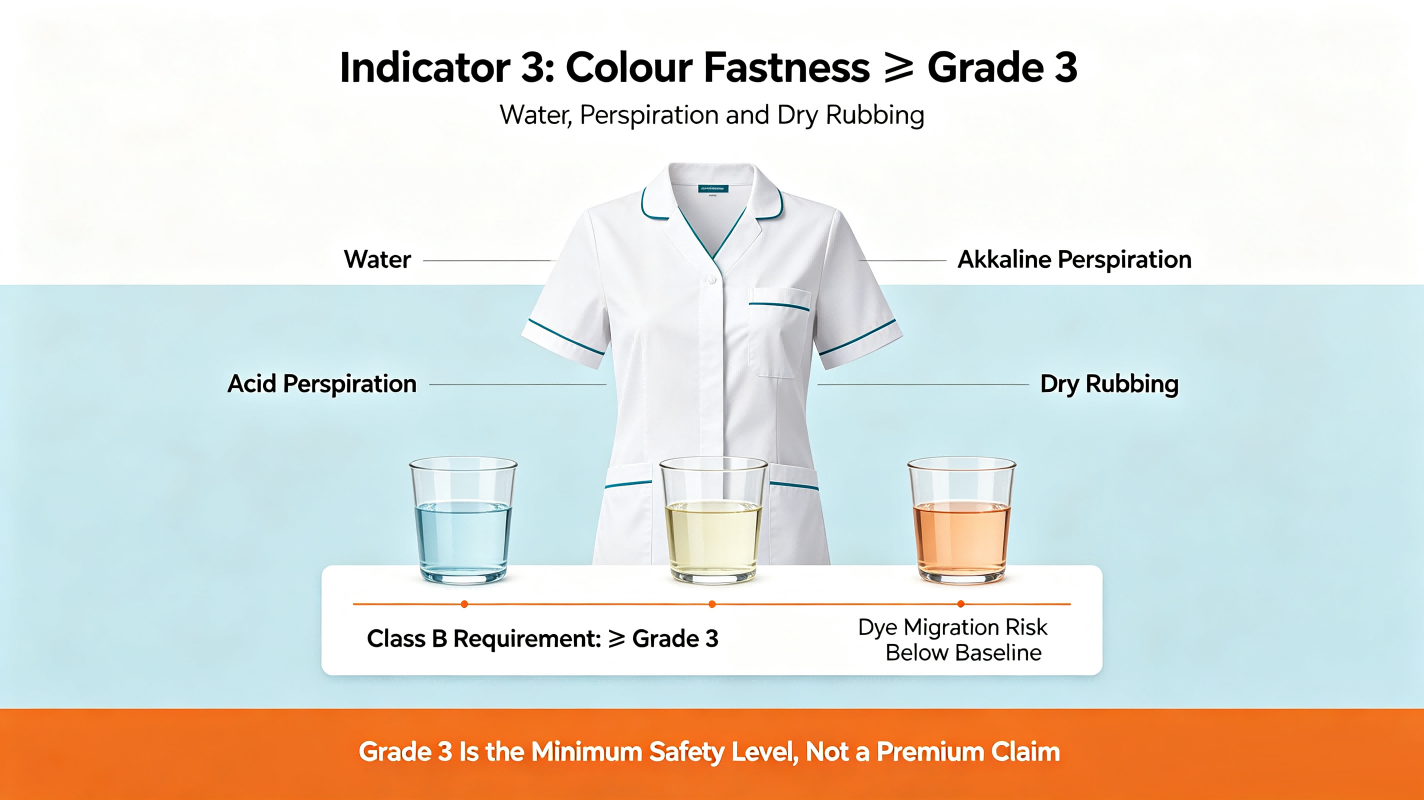
Indicator 3: Colour fastness (to water, perspiration, dry rubbing) ≥ grade 3
Poor colour fastness means dye easily comes off. Nurses sweat heavily at work; if dye on the fabric comes off after soaking in perspiration, it may transfer to the skin. Class B requires ≥ grade 3 for colour fastness to water, acid perspiration, alkaline perspiration, and dry rubbing. Grade 3 is not particularly high, but it is the baseline – below this level, the risk of dye "migrating" is unacceptable.
Indicator 4: Odour – none
The standard requires Class B products to have no odour. Musty, petrol-like, fishy, or aromatic hydrocarbon odours often point to residual chemicals or improper storage. These are safety signals, not "the smell of new clothes."
Indicator 5: Decomposable carcinogenic aromatic amine dyes – prohibited
This is the most serious of the five in terms of consequences. These dyes decompose under certain conditions to release carcinogenic aromatic amines, and long-term exposure carries health risks. GB 18401's stance is prohibited, with a limit value of ≤20 mg/kg (essentially equivalent to not detected). For nurse uniforms – workwear worn against the skin for long periods – there is no room for negotiation on this point.
4. Looking at Class A, B, and C together – where the gaps are
|
Indicator |
Class A (infants and toddlers) |
Class B (direct skin contact) |
Class C (non-direct skin contact) |
|
Formaldehyde (mg/kg) |
≤20 |
≤75 |
≤300 |
|
pH value |
4.0–7.5 |
4.0–8.5 |
4.0–9.0 |
|
Colour fastness to water (grade) |
≥3-4 |
≥3 |
≥3 |
|
Colour fastness to dry rubbing (grade) |
≥4 |
≥3 |
≥3 |
|
Odour |
None |
None |
None |
|
Decomposable carcinogenic aromatic amine dyes |
Prohibited |
Prohibited (≤20 mg/kg) |
Prohibited |
Data source:
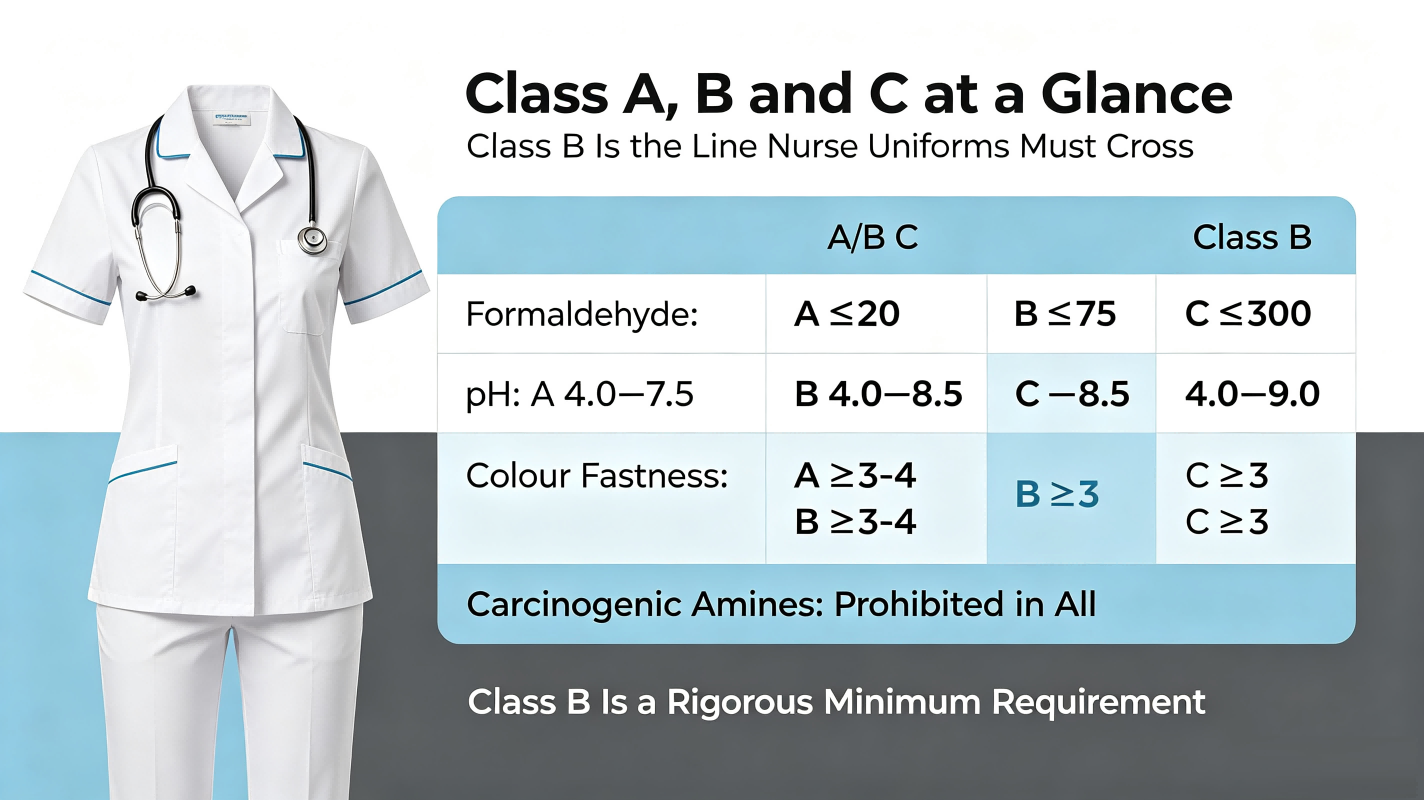
Class B is not the highest standard, but it is the line nurse uniforms must cross. Class A is of course safer, but costs more. For adult nurse uniforms, Class B is a reasonable and rigid minimum requirement. The question is not "can it achieve Class A," but whether it has achieved Class B at all.
5. When buying nurse uniforms, how do you verify using GB 18401 Class B?
Knowing what the standard is, the next step is knowing how to use it.
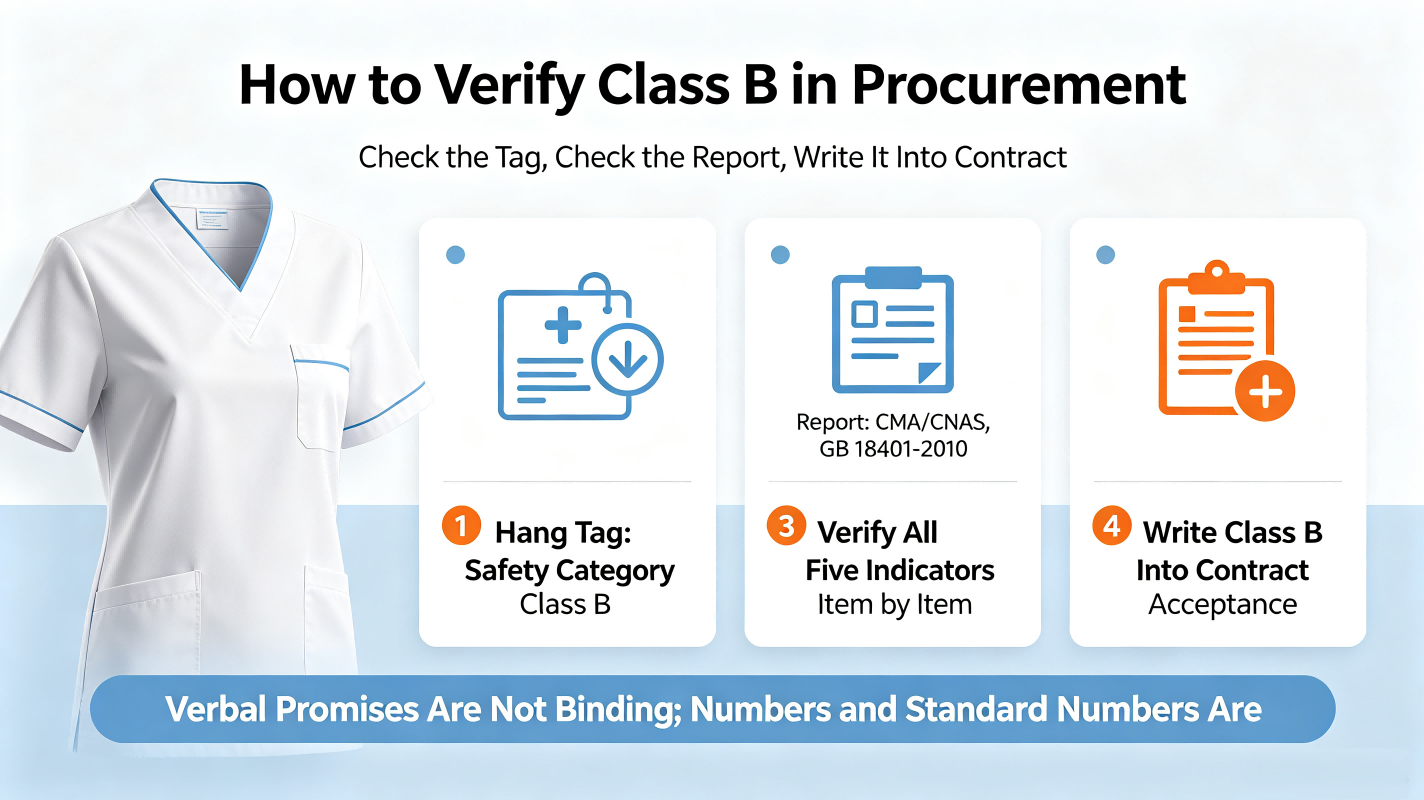
First, check whether the hang tag says "Class B."
The instructions for legitimate nurse uniforms must state the safety category they comply with. If you cannot find "Safety category: Class B" on the hang tag or care label, that is an immediate red flag. If they don't even dare to label the category, there is no need to discuss other indicators.
Second, ask for a test report – don't just rely on "claims."
The five Class B indicators need third-party test data to support them. Require the supplier to provide a test report issued by a CMA- or CNAS-accredited testing institution according to GB 18401-2010, and check each item: whether formaldehyde is ≤75, whether pH is within 4.0–8.5, whether colour fastness is ≥ grade 3, whether odour is "none," and whether decomposable carcinogenic aromatic amine dyes are "not detected" or ≤20 mg/kg.
Third, beware of the mismatch of "making outerwear to Class B, buying next-to-skin items as Class C."
In the same procurement batch, if it includes nurse uniforms (next-to-skin) and outerwear (non-next-to-skin), you cannot simply order everything as Class C because "it's all workwear." Nurse uniforms, scrub suits, and short-sleeve items that come into direct contact with skin must be confirmed item by item as Class B. The wording in hospital procurement – "scrub suits (short-sleeve) finished products must comply with GB 18401-2010 Class B (products in direct contact with skin)" – is the correct approach.
Fourth, write Class B into the contract acceptance clauses.
Don't just write "complies with national standards." Write clearly: Complies with GB 18401-2010 Class B; formaldehyde ≤75 mg/kg; pH 4.0–8.5; colour fastness to water, perspiration, and dry rubbing ≥ grade 3; no odour; decomposable carcinogenic aromatic amine dyes prohibited (≤20 mg/kg). For bulk sampling, send samples to a third party for testing against these items; failures are treated as a breach of contract. Verbal promises have no binding force—numbers and standard numbers do.
6. A common misreading: "Class B is just medium – roughly good enough"
There is a mindset that goes: Class A is best, Class B is "good enough," and Class C "can also be worn." This understanding may hold for ordinary outerwear, but it does not hold for nurse uniforms.
The wearing scenario of nurse uniforms leaves no room for "downgrading." Against the skin 8 to 12 hours a day, sweating, friction, repeated washing – the time and intensity of contact between chemical residues and shedding dyes on the fabric and the skin far exceed those of an outer coat worn occasionally. Class C's 300 mg/kg formaldehyde limit and wider pH range are designed for products that are not worn next to the skin and are in contact for short periods—not for nurse uniforms.
Class B is not "roughly." It is the minimum safety qualification for nurse uniforms.
A final honest word
The "Class B" on a nurse uniform hang tag is not decoration, not an optional label – it is the safety baseline drawn by the mandatory national standard GB 18401-2010 for products in direct contact with skin.
Formaldehyde ≤75 mg/kg, pH 4.0–8.5, colour fastness ≥ grade 3, no odour, decomposable carcinogenic aromatic amine dyes prohibited—these five numbers form the basic criteria for judging whether a nurse uniform "can be worn against the skin every day."
When buying, don't just ask "How much per piece?" First, flip the hang tag: Is the safety category Class B? Then ask for the report: Do all five indicators match item by item? If a nurse's uniform cannot even be labelled and tested as Class B, then the cost it saves is not fabric cost—it is safety margin.
Nurse uniforms are the battle gear nurses wear every day. Class B is not a high standard, but it is a non-negotiable starting point.